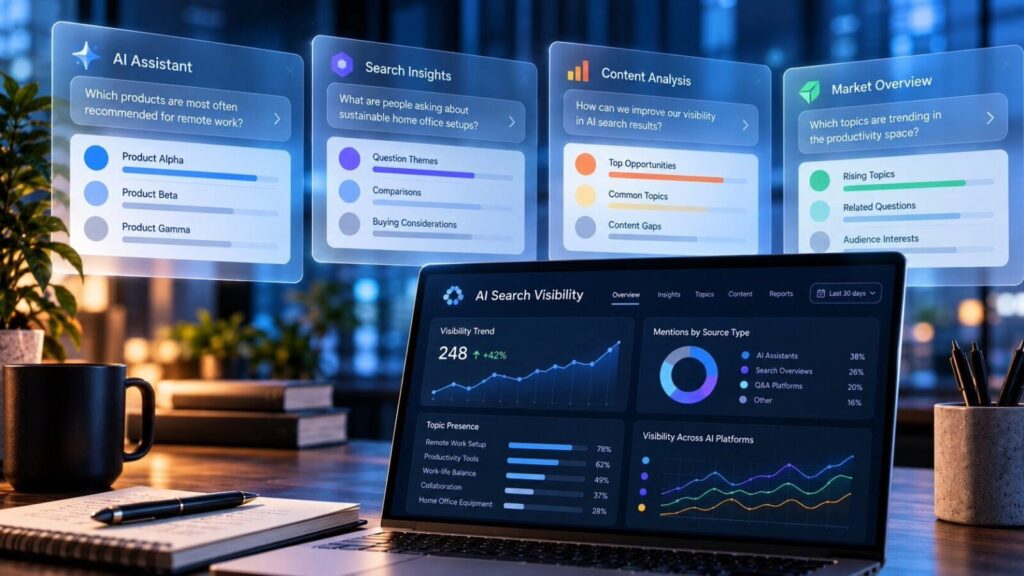
Tracking visibility in AI search is not as simple as checking where your business “ranks” in ChatGPT, Gemini, Perplexity, or another AI platform. There is no universal results page, fixed position, or complete list of the prompts people use when your business should appear.
Table of contents
Different AI platforms may return different answers, sources, and recommendations for similar prompts. The output from an AI search can change frequently, but useful tracking signals and patterns can still emerge from the noise.
"I searched my company in ChatGPT and it showed up,” however, is not a valid reporting methodology.
What Can You Actually Track in AI Search?
You can track signals of AI search visibility, even without a single ranking or score. No one measurement gives you the full picture, so the goal is to compare several useful signals over time rather than treat any one result as definitive.
Brand Appearances Across Tracked Prompts
Build a defined prompt set around important services, questions, topics, and locations, then repeat those searches over time. For service businesses, compare broader prompts with city-, metro-, and region-specific versions.
- Did your business appear?
- Which AI platform surfaced it?
- Did the service, location, or wording change the result?
- Was the brand mentioned, recommended, or simply referenced?
Citations & Linked Sources
Track which of your pages AI platforms cite or link to and which outside sources repeatedly appear for the topics you care about. Those patterns can show what information the platform is relying on when it builds an answer and provide context for how AI platforms choose what to cite.
Third-party information matters, too. Reviews, directories, articles, and other sources may reinforce details about your business even when your website is not cited directly. Accurate local citations can be part of that broader search presence.
AI Referral Traffic
AI referral traffic gives you one of the clearest ways to connect AI visibility with actual website activity. Google Analytics now includes an AI Assistant channel for traffic it recognizes from supported AI platforms, although some AI-driven visits may still appear under other traffic sources.
- Which AI platform sent the visit
- Which page the visitor landed on
- How they engaged with or moved through the site
- Whether they completed an inquiry, conversion, or other meaningful action
Landing page design and conversion rate optimization matter here because a referral has limited value if the visitor arrives and goes nowhere.
Supporting Search Performance
Traditional SEO data does not prove AI visibility, but it can show whether the pages behind your strategy remain discoverable. Watch indexing, impressions, clicks, rankings, and performance around the topics you want associated with the business.
If those pages are not being indexed, found, or understood through search, weak AI visibility may reflect a broader problem with the content or site rather than the AI platform alone. That overlap is part of how AI is changing search and SEO.
These are signals, not an AI ranking report. Taken together, they matter more than any one result.
Best AI Search Visibility Tools
AI visibility platforms can make these signals easier to monitor by repeating prompts, collecting citations, comparing competitors, and showing changes over time.
Our take: Use AI visibility tools to spot repeatable patterns, not to chase a single score. The best fit depends on what you already use, what you need to monitor, and how important AI-search reporting is to your business.
These tools do not provide a complete record of every AI answer or user interaction. The useful question is which signals a tool can consistently observe and compare.
Ahrefs Brand Radar
Best fit: SEO teams already working in Ahrefs.
What it can show: Brand mentions, citations, AI share of voice, estimated impressions, and competitor visibility.
What it does not prove: That AI visibility is producing qualified traffic or leads.
Semrush AI Visibility
Best fit: Teams already using Semrush for SEO and reporting.
What it can show: Brand visibility, prompts, competitors, sentiment, and AI-search performance alongside broader SEO data.
What it does not prove: A complete picture of every AI interaction involving the brand.
Profound
Best fit: Dedicated AI-search monitoring and competitive analysis.
What it can show: Prompt visibility, citations, sources, competitors, sentiment, and changes across AI platforms.
What it does not prove: A stable ranking equivalent to a Google SERP.
Scrunch
Best fit: AI visibility plus crawler and agent activity.
What it can show: Brand presence, citations, competitor visibility, AI bot traffic, response position, and referral activity.
What it does not prove: That a crawl, citation, or appearance automatically produces a customer or lead.
OtterlyAI
Best fit: Recurring prompt, brand, competitor, and citation monitoring.
What it can show: Mentions, citations, sentiment, share of voice, prompt results, and changes across AI engines.
What it does not prove: What every real user is actually asking an AI platform.
Peec AI
Best fit: Brand and competitor visibility across AI engines.
What it can show: Visibility, position, sentiment, share of voice, prompts, competitors, and cited sources.
What it does not prove: A universal ranking that stays consistent for every user, prompt, or response.
*Capabilities and product features reflect publicly available information as of fall 2026 and may change as these platforms develop.
Why Are Competitors Showing Up in AI Search When I'm Not?
Competitors may show up more often in AI search because search systems have stronger or more consistent signals connecting those businesses to the service, topic, location, or problem in the prompt. Repeated visibility suggests those associations are reinforced across the sources AI platforms use to build an answer.
Over time, a few patterns may stand out:
- The same business shows up for several related questions
- Another brand keeps appearing for certain services or locations
- Reviews, articles, directories, or other sources keep pointing back to that business
Those patterns can point toward gaps in your own topic coverage, location signals, supporting pages, or outside mentions.
An AI result does not tell you exactly why another business was selected. It gives you a place to investigate. Comparing the right signals over time can help show where your presence differs and what may need attention.
How AI Search Represents Your Business
How an AI platform describes and positions your business can reveal what it associates with your brand. Inaccurate or incomplete information may be repeated across different prompts and platforms, reinforcing the wrong services, locations, expertise, or expectations.
How are you described?
Look at the services, expertise, locations, and customer needs connected with your business when it appears.
What keeps showing up with your name?
Repeated associations can reveal which parts of the business AI systems appear to understand clearly and which may be missing or distorted.
Does that match the business you actually want represented?
AI search optimization works differently from SEO, but the same business information still matters. Wrong locations, outdated services, weak expertise signals, or misleading descriptions can confuse search systems and potential customers alike.
Those gaps can help explain why your website is not showing up in AI search as expected and where a broader AI search optimization strategy may need to focus.
AI Search Visibility FAQs
Q: What Can I Do to Improve My Visibility in AI Search?
Start by making it easier for search systems to understand what your business does, where it operates, and why it is relevant. Some of the basics are familiar because AI search still relies on information published across websites, business profiles, directories, reviews, and other online sources.
- Keep important service, location, and company information accurate
- Build useful content around the topics and questions customers actually care about
- Make sure important pages can be found, crawled, and indexed
- Pay attention to reviews, directories, articles, and other outside mentions of the business
The goal is not to manipulate one ChatGPT answer. It is to give search systems a clearer and more consistent picture of the business over time.
Q: Is Content Important for AI Search Visibility?
Yes, but simply publishing more content is not automatically better. Useful pages help establish which services, topics, locations, questions, and areas of expertise should be associated with your business.
If a site already has substantial content but important pages are not being found, indexed, or associated with the right topics, a broader SEO audit may reveal problems that adding another article will not fix.
Q: Does My Website Matter in AI Search?
Yes. Your website helps establish what your business does, where it works, and what expertise should be associated with the company. It can also provide details that are difficult to reduce to a business listing or short AI answer.
- Detailed service and location information
- Case studies, experience, and credentials
- Forms, quote requests, booking options, and other ways to take action
AI platforms may also rely on outside sources, but an outdated or incomplete site can still create a larger visibility problem. If the website no longer reflects the business, the issue may extend beyond AI search and into the broader cost of rebuilding a website.
Q: What Should I Do If AI Search Shows Incorrect Information About My Business?
Start with the information you control. Check whether your own website still contains outdated services, old locations, inconsistent descriptions, or other details that could be contributing to the problem.
Then look at the outside sources connected with the incorrect information. Reviews, directories, articles, profiles, and other third-party pages may need to be corrected where possible. An isolated error may not repeat, but recurring misinformation is worth tracing back to the sources that may be reinforcing it.
Q: How Often Should I Check My AI Search Visibility?
Often enough to identify patterns, not so often that every changing answer becomes an emergency. Repeating a useful set of prompts on a consistent schedule can tell you more than checking random questions every day and reacting to individual results.
Q: Should I Track ChatGPT, Gemini, Perplexity, and Google AI Results Separately?
Yes. Different AI platforms can use different sources, interpret prompts differently, and return different businesses for similar questions.
Tracking them separately makes those differences visible. The larger goal is still to identify repeatable patterns across platforms rather than invent one universal “AI ranking” that does not really exist.
Turn AI Search Visibility Into Something Useful
AI search reporting should help a business understand where it appears, how it is being represented, and which underlying search, content, website, or reputation problems deserve attention. A broader AI search optimization strategy can use those signals to decide what is worth improving instead of chasing one prompt or dashboard score.
- Track patterns instead of individual answers: Repeated appearances, citations, referrals, and competitor visibility are more useful than a favorable screenshot.
- Pay attention to how the business is represented: Visibility has limited value if AI platforms associate the company with the wrong services, locations, expertise, or customer needs.
- Fix the problem behind the signal: Weak AI visibility may point back to content gaps, search performance, website issues, inconsistent business information, or weak supporting signals around the topic.
Not sure what your AI search visibility is telling you? Contact Hexxen for a quote or call (314) 499-8253 to look at what is showing up, what may be missing, and where the next investment makes sense.