You've got a business, customers, and a website. Maybe you're doing well enough already. But you want more work, better customers, or a way into a market where nobody knows your name.
Google will gladly take your advertising money. Whether it's worth it depends on what you want that money to accomplish.
Table of contents
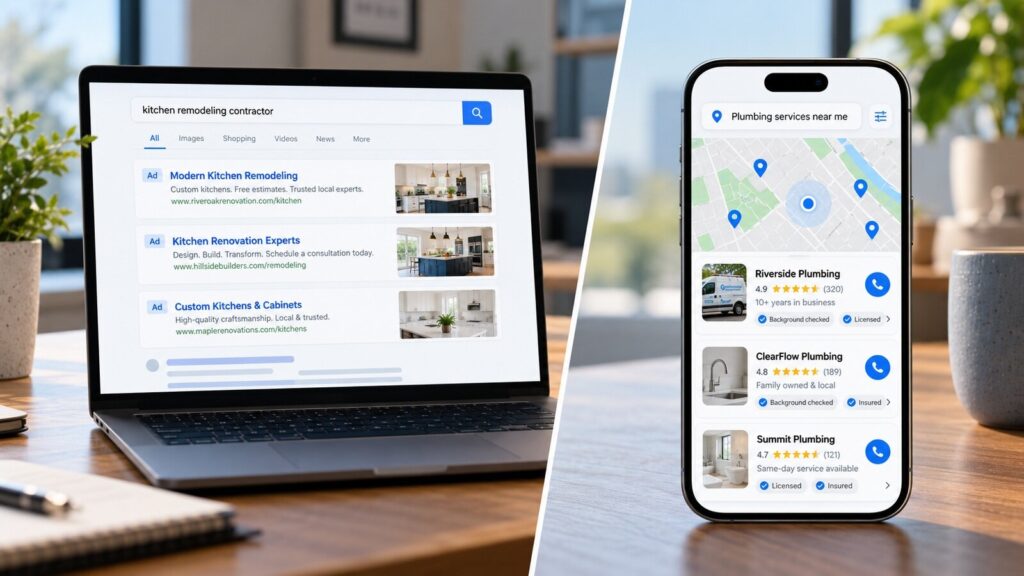
Google Search Ads generally charge for clicks, while Local Services Ads (LSAs) charge for valid leads. Both help businesses reach prospective customers, but they serve different purposes and sometimes work together.
Before spending anything, decide what kind of business you're trying to generate.
Key Takeaways
- Paid advertising helps businesses reach customers in specific markets or promote particular services.
- Google Search Ads and LSAs may work together to pursue different business goals.
- Advertising costs should be evaluated against the customers acquired and the profit they generate.
*2026 Update: Local Services Ads Are Moving into Google Ads
Google is moving Local Services Ads (LSAs) into the Google Ads platform, with the transition continuing through 2027. LSAs are not being discontinued. The pay-per-lead model remains, but campaign management and reporting are changing. Existing advertisers should review Google's migration details before their accounts move.
What does this mean for advertisers?
Same purpose, new home: LSAs still focus on local leads, while traditional Search Ads offer broader keyword and messaging control. Businesses can continue using them for different goals.
Pay attention to your account: Watch for migration notices and changes to campaign management.
Save your historical reports: Previous LSA reporting data won't automatically transfer to the new system.
Why Pay Google to Advertise When Organic Search Exists?
Organic search gives businesses a way to attract customers without paying for every visit. That visibility takes time to build, but established rankings can continue bringing in business long after a page is published.
Paid advertising offers a faster way to reach customers, especially when a business wants to compete somewhere its organic visibility hasn't caught up.
Enter a new market: Reach customers in locations where your business has little existing visibility.
Promote specific services: Attract customers looking for the work you want more of.
Fill scheduling gaps: Generate inquiries ahead of slower periods or seasonal demand.
Reach different customers: Pursue audiences your existing marketing isn't reaching.
Unlike organic visibility, paid advertising generally stops delivering exposure when you stop paying. That's the tradeoff.
Buying Clicks with Google Search Ads
Google Search Ads give businesses control over target keywords, excluded keywords, geographic targeting, budgets, and ad messaging.
Under the traditional pay-per-click (PPC) model, businesses pay when someone clicks an ad, not when that person becomes a customer.
What happens after the click determines whether that expense becomes a business opportunity. A well-designed landing page gives visitors a reason to contact you, request a quote, or make a purchase.
That control becomes especially useful when a business wants to attract a particular kind of customer.
Consider a fictional financial software company:
Current Business: An established customer base generating repeat business.
New Goal: Win larger corporate contracts by reaching the decision-makers who control purchasing budgets.
The catch is that more individual subscribers won't advance the company's new goal. Instead, its Search Ads could introduce corporate buyers to its enterprise capabilities, integrations, and product demonstrations months before they're ready to make a purchasing decision.
Immediate sales aren't the only measure of success for this campaign. Reaching the right decision-makers and generating qualified interest matter more than accumulating clicks or email signups.
What this means for advertisers: Spending more to reach a qualified corporate buyer may make sense when a single contract is worth substantially more than an individual subscription. The budget needs to account for a longer sales cycle, not just the cost of generating a click.
Local Services Ads: Paying for Leads
Local Services Ads (LSAs) connect people searching for eligible local services directly with businesses in their area. The listings emphasize the provider, including Google's customer reviews, verification information, and contact options.
Businesses choose which eligible services to advertise and where they want to receive inquiries. Google matches those services and locations to relevant searches.
Unlike traditional Search Ads, LSAs charge for valid leads instead of clicks. But paying for an inquiry doesn't mean winning the job.
Here is a fictional regional roofing contractor:
Current Business: Steady residential work through referrals and repeat customers.
New Goal: Generate more residential roof replacement estimates in neighboring suburbs.
LSAs could put this roofing company in front of homeowners actively searching for roof replacement services in neighboring suburbs. Instead of paying for website visits, the company pays for valid leads from prospective customers.
A valid lead isn't a guaranteed customer. The roofing company still needs to answer inquiries, provide estimates, and win enough jobs to justify the advertising expense.
Using Google Ads & LSAs for Different Business Goals
Let's return to our fictional roofing company. Residential estimates are coming in, but now the company wants to pursue larger commercial roofing contracts.
That's a different customer with a different buying process. The company could use separate advertising approaches for each goal:
| What the Roofer Wants | Possible Approach |
|---|---|
| Residential roof replacements | LSAs to generate inquiries from homeowners in selected service areas |
| Commercial roofing contracts | Search Ads targeting commercial roofing projects and directing buyers to relevant service pages |
The roofing company doesn't have to split its budget evenly. It might prioritize residential leads during one season and commercial opportunities during another, depending on available work and the value of each contract.
Even within one business, different advertising goals may call for different campaigns and budgets.
What Should Different Businesses Expect from Google Advertising?
Not every business needs a steady stream of leads. Some advertise to capture immediate demand, while others want to reach buyers long before a purchase. The goal changes what a useful result looks like.
| Business | Advertising Goal | What to Measure |
|---|---|---|
| Home Services | Reach people who need immediate or scheduled services | Qualified calls, estimates, and booked jobs |
| Retail & Ecommerce / DTC | Sell selected products or promote special offers | Sales, acquisition costs, and return on ad spend |
| Legal & Financial Services | Attract clients seeking specialized services | Qualified consultations and new clients |
| Manufacturing & Construction | Reach commercial buyers and decision-makers | Qualified opportunities, quote requests, and contracts or orders |
| Events & Seasonal Businesses | Generate demand during important sales windows | Bookings and sales during the campaign |
The right measurements depend on what the advertising is supposed to accomplish. A booked emergency appointment and a six-month corporate sales opportunity represent very different buying decisions.
How Much Should You Spend on Google Advertising?
Advertising budgets should reflect what a new customer is worth to the business, not just how much it costs to attract one.
Consider two hypothetical outcomes from paid advertising:
Campaign A: Residential Jobs
$400 in advertising generates four jobs worth $500 each.
Revenue: $2,000 | Ad Spend: $400
Campaign B: Commercial Contract
$1,000 in advertising generates one $8,000 contract.
Revenue: $8,000 | Ad Spend: $1,000
Campaign B generates more revenue relative to its advertising cost. But that commercial contract might require a larger crew, expensive materials, or weeks of preparation. The residential jobs could be less expensive to complete and more likely to bring repeat business.
Revenue isn't profit, and a cheaper lead isn't necessarily a better lead.
Before increasing ad spend, businesses should understand:
- Cost per click or valid lead
- How many inquiries become paying customers
- Revenue and profit per customer
- Time and resources required to close a sale
- Capacity to handle additional business
A useful advertising budget accounts for these numbers alongside competition and market demand. What matters is how much profitable business the spending produces.
What Does Google Ad Management Include?
Launching a campaign is one thing. Managing where the money goes and what it produces is another.
Campaign Setup & Targeting: Select keywords, audiences, locations, budgets, and messaging based on the business's goals. For LSAs, this includes eligible services and geographic coverage.
Lead Generation & Conversion: Improve landing pages through conversion rate optimization (CRO), track customer inquiries, and identify which clicks or leads turn into actual business.
Performance & Spending: Review results, adjust campaigns, and decide where additional advertising dollars are justified.
Professional management should go beyond reporting clicks and impressions. The real question is whether the advertising is producing business worth paying for.
What Are You Paying for with Google Ads Management?
Management fees are separate from ad spend. Agencies may charge a flat monthly fee, a percentage of spending, or use performance-based pricing.
Before hiring an agency, ask:
What's included? Campaign setup, ongoing adjustments, and account ownership.
How often is the work reviewed? Campaign performance, targeting, and spending decisions.
What gets reported? Qualified leads, customers acquired, and results beyond clicks and impressions.
Google Advertising FAQs
Q: Are Local Services Ads Better Than Google Search Ads?
Not necessarily. LSAs are designed to generate leads for eligible local services. Search Ads give advertisers more control over keyword targeting, messaging, and where customers go after clicking. Some businesses benefit from both.
Q: Can Small Businesses Afford Google Ads?
Yes, but a small budget needs a narrow purpose. Rather than compete for every relevant search, businesses might use limited spending to:
- Protect their name: Advertise on branded searches where competitors may also be bidding.
- Compete selectively: Appear for a handful of valuable searches without trying to outspend larger advertisers across the board.
- Capture right-now opportunities: Promote limited-time offers, available inventory, or services when demand spikes.
A small budget may not produce a steady stream of customers. But it can still accomplish something useful when the campaign has a specific objective.
Q: Can You Run Google Search Ads and LSAs at the Same Time?
Yes, provided the business qualifies for LSAs. A roofer, for example, might use LSAs to generate residential estimates while running Search Ads aimed at commercial property managers.
Q: Can I Just Outspend My Competitors on Google Ads?
You can certainly try. A larger budget gives you more opportunities to compete, but it doesn't guarantee better ad placement or more customers. Google's ad auctions also consider bid amounts, ad quality, and landing page experience.
A smaller advertiser can still compete by targeting valuable searches and getting more business from the clicks it pays for. Spending smarter can beat spending more.
Is Advertising on Google Worth It?
It can be, provided the advertising has a clear purpose and the business knows what success looks like.
Start with the business goal. Decide which customers or contracts you want before choosing where to advertise.
Spend with a purpose. A limited budget targeting the right opportunity may accomplish more than a larger campaign chasing every possible customer.
Measure what matters. Clicks and leads have costs, but the customers and profit they produce determine the return.
Ready to put your advertising budget to work? Contact Hexxen or give us a call at (314) 499-8253 to discuss Google Ads management, Local Services Ads, and campaigns built around your business goals.