

Google Ads for Law Firms
Part 2, Chapter 2: Getting the Right Leads With Google Ads
Table of contents
Two people search Google for help with a car accident. One wants to understand how insurance claims work. The other needs an attorney after a serious collision. A law firm advertising on Google may reach both, but those searches represent different needs and opportunities.
Google Ads gives law firms a way to compete for relevant searches, but paying for visibility doesn't guarantee qualified clients. Keywords, bidding, ad relevance, and campaign targeting influence who sees an ad and what the firm pays. Getting those decisions wrong can become expensive quickly.
Key Takeaways
- Keywords, search intent, bids, and relevance all affect when and where ads appear.
- Lead quality matters more than click volume alone.
- Poor targeting, weak tracking, and bad conversion signals can make a campaign efficient at wasting money.
Getting Your Legal Ads to Show Up on Google
Google does not automatically show the ad from the firm that pays the most. Each search triggers an auction that considers both what advertisers are willing to pay and how well the ad matches the search. Google Ads is not a simple bidding war. A campaign needs enough budget to compete, but relevance still matters.
| Factors That Influence Which Google Ads Show | |
|---|---|
| Your Bid | How much the campaign is willing to pay for the opportunity. |
| Ad Relevance | How closely the ad matches the search or legal issue. |
| Expected Performance | How likely Google thinks someone is to interact with the ad. |
| Landing-Page Experience | How useful and relevant the destination appears after the click. |
| Competition | What other advertisers are trying to show for the same search at that moment. |
Deciding Which Legal Searches to Pay For
Google Ads does not simply show an ad every time someone types the exact keyword a firm selected. Keywords help define the searches a campaign wants to reach, but the actual search terms that trigger ads can be broader, narrower, or very different from what the firm expected.
The practical job is to keep more of the budget flowing toward searches connected to the cases the firm actually wants. That kind of active search management is an important part of making paid advertising useful instead of simply buying visibility.
Keywords Set the Direction
Keywords tell Google what kinds of searches the campaign wants to reach. A broad keyword such as "injury lawyer" gives Google room to match the ad with many related searches.
Search Terms Show What People Actually Typed
The exact phrases people use are called search terms. Reviewing them can reveal useful case-specific searches, but also traffic tied to the wrong jurisdiction, services the firm does not handle, or people looking for jobs, forms, definitions, or free information.
Negative Keywords Help Cut the Waste
Negative keywords help prevent ads from appearing for searches the firm doesn't want to pay for. For example, a personal injury firm that doesn't handle workers' compensation cases might exclude related search terms from its campaign. Without those exclusions, broader keyword targeting can attract inquiries about services the firm doesn't provide.
Bidding on Google Ads | What Law Firms Should Focus On
Bidding strategy can get complicated quickly, but law firms do not need to understand every adjustment Google makes in an auction. They do need to understand what the campaign is trying to accomplish and how those goals affect where the budget goes.
1. Define the Business Goal
"More clients" is not specific enough. A firm should know which case types it wants more of, which markets matter, and what a useful result looks like. A click, call, consultation, and retained case are not the same outcome.
2. Give Google the Right Signals
Automated bidding relies on the information the campaign receives. If weak leads, accidental calls, or low-value actions are treated as successful conversions, Google can become very efficient at producing more of the wrong thing.
3. Match the Bidding Strategy to the Goal
A campaign focused on traffic can behave very differently from one focused on conversions, acquisition cost, or value. The bidding approach should support the result the firm actually cares about.
4. Do Not Micromanage Every Auction
Google evaluates searches, devices, locations, timing, competition, and other signals across a large number of auctions. Constant manual adjustments can create activity without improving the campaign.
5. Do Not "Set It and Forget It"
Campaigns still need to be reviewed for wasted spend, changing lead quality, poor conversion signals, and shifts in the cases or markets the firm wants to pursue.
How Much Do Google Ads Cost for Law Firms?
There is no single cost for legal advertising on Google. A click for one practice area in one market may cost dramatically more than another, and the potential value of a case can change what a firm is willing to spend.
Practice Area & Case Type
- Different case types attract different levels of advertiser demand
- Competitive matters may require higher bids to appear consistently
- The cases a firm wants to target influence how aggressively it competes
Geographic Market
- Large metros may have more firms competing for the same searches
- Search volume can vary sharply by market
- Case values and competition may differ by jurisdiction
Competition
- National and regional firms may compete with local practices
- Referral businesses may also bid on the same searches
- Some firms spend aggressively on only a few valuable case types
Keyword & Search Intent
- Broad informational searches may be farther from hiring an attorney
- Specific, high-intent searches may attract more competition
- Cheap traffic is not automatically efficient traffic
What Should Legal Google Ad Campaigns Target?
Legal campaigns can look very different depending on the case type, urgency, and what the firm wants to attract. The search, ad, landing page, and desired result should all point toward the same kind of legal matter.
Personal Injury | Immediate Need
Possible Search: "Do I need a lawyer after a car accident?" or "car accident lawyer near me"
Ad Focus: The accident type, local representation, and an easy way to contact the firm.
Landing Page: A car-accident or injury page that addresses the same problem and makes the next step clear.
Useful Result: A qualified call or consultation involving an accident case the firm handles.
Divorce & Family Law | Comparing Options
Possible Search: "Do I need a lawyer for a divorce?" or "divorce attorney cost"
Ad Focus: The specific family-law service, consultation process, and the market the firm serves.
Landing Page: A divorce or family-law page with relevant experience, process information, and a clear consultation path.
Useful Result: A consultation request involving the right case type and jurisdiction.
Criminal Defense | Urgent Search
Possible Search: "What happens after a DWI arrest?" or "DWI lawyer near me"
Ad Focus: The charge, immediate access to help, and the jurisdiction the firm serves.
Landing Page: A charge-specific page that answers immediate questions and makes contact information easy to find.
Useful Result: A direct inquiry from someone who needs representation and fits the firm's case criteria.
Business Law | Higher-Consideration Search
Possible Search: "Do I need a lawyer to review a business contract?" or "business contract attorney"
Ad Focus: The specific business problem, legal service, and relevant experience.
Landing Page: A service-specific business-law page that explains how the firm can help with that type of matter.
Useful Result: A qualified inquiry tied to a business matter the firm wants and is prepared to handle.
How to Measure Google Ads Performance
Clicks and impressions show what is happening inside the campaign, but they do not show what the advertising is producing for the firm. Useful measurement follows the path from initial activity to actual legal work.
A low cost per lead may look efficient until most of those leads turn out to be outside the firm's jurisdiction or involve matters it does not accept. Fewer, more expensive leads may be far more valuable if they consistently turn into retained cases.
Lead quality matters alongside lead volume. Google reports what happened on the website or during a tracked call, while intake helps show which conversions were actually worth paying for. That information then helps improve targeting, bidding, ads, and budget decisions.
Ways to Waste Your Google Ads Budget
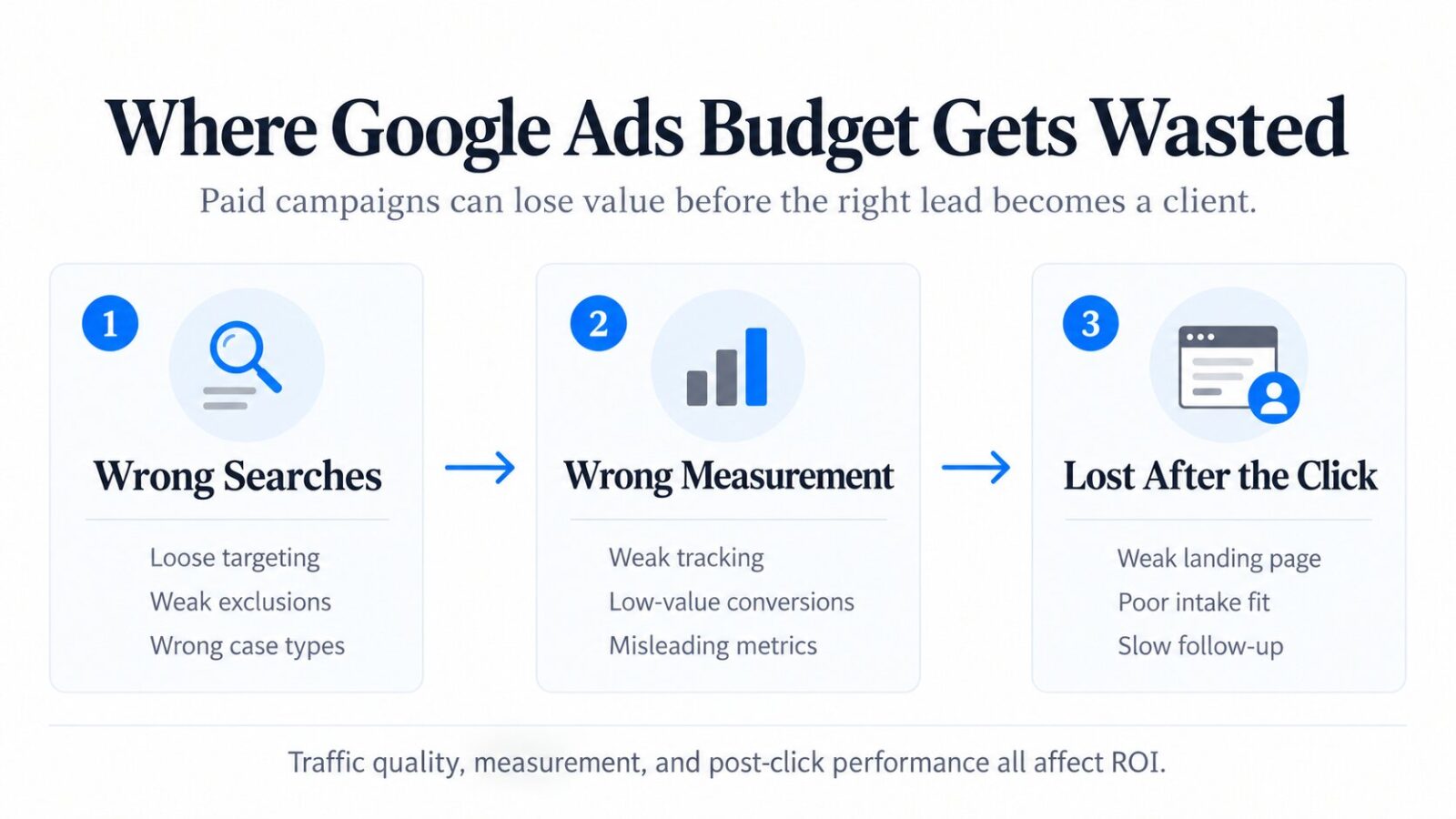
Google Ads burns through budget quickly when a campaign reaches the wrong searches, tracks the wrong signals, or loses value after a good click. Most wasted spend comes back to a few familiar problems inside the campaign or immediately after it.
Ways to Waste It
- Pay for search terms outside the firm's real case criteria
- Count weak calls, clicks, or form submissions as successful Google Ads conversions
- Judge campaign performance by cheap leads instead of qualified cases
- Send useful paid-search traffic into weak landing pages, intake, or follow-up
Better Ways to Use the Budget
- Focus Google Ads spend on the searches, case types, and markets the firm actually wants
- Track conversions that represent meaningful progress toward a qualified client
- Compare Google Ads data with lead quality, consultations, and retained cases
- Use search-term, intake, and performance data to improve targeting, bidding, and landing pages
Google Ads performance becomes much easier to judge when the firm connects the search, the conversion, and the eventual case. That makes it clearer where the budget is working and where the campaign needs to change.
Is Google Ads Worth It for Law Firms?
Google Ads is often worth it for law firms that know which searches and cases they want to compete for.
The value of Google Ads depends less on generating clicks than on reaching the searches most likely to produce the cases the firm actually wants.
Keywords, bidding, conversion signals, landing pages, and lead quality all shape what Google does with the budget. When those pieces line up, paid search becomes a useful source of qualified legal inquiries.