

Paid Advertising for Law Firms
Part 2: Buying Visibility & Generating Leads
Table of contents
A law firm wants to attract more personal injury cases in a competitive market. It could spend months building organic search visibility, or it could pay to appear in front of people already looking for legal help. Paid advertising creates that opportunity through search engines, social media, legal directories, and other digital channels.
Buying visibility doesn't guarantee valuable cases. A firm needs to know which services it wants to promote, who it wants to reach, and what a useful result is worth. More clicks mean little if they don't lead to the right inquiries.
Key Takeaways
- Paid advertising creates faster visibility than organic marketing, but that visibility comes with a direct cost.
- More traffic does not automatically mean better advertising. Lead quality and potential case value matter more than raw click volume.
- Ads, landing pages, conversion tracking, and intake all shape what happens after someone clicks.
- Paid advertising needs active management as costs, competition, targeting, and performance change over time.
Why Do Law Firms Use Paid Advertising?
Organic visibility takes time. Paid advertising gives law firms a faster way to reach a specific service, case type, market, or audience.
Paid ads move fast. Good decisions create opportunities quickly; bad ones get expensive just as fast.
WHEN PPC WORKS OUT
Paid Ads Are Quick and Precise
Campaigns give firms control over audience, geography, and budget, with relatively clear ways to measure spend and response.
THE NIGHTMARE SCENARIO
Paid Ads Burn Money Fast
Bad targeting, weak landing pages, poor tracking, and low-quality leads can burn through a meaningful budget with little business value.
When PPC Has a Narrower Job
Not every paid campaign is built around generating the largest possible volume of leads. Sometimes the reason to advertise is narrower.
Brand protection: A law firm may advertise on searches for its own name to defend prominent search visibility, especially when competitors or legal directories are also bidding for that traffic.
Highly specific case types: A firm may pursue a narrow set of searches because the right matter is especially valuable, even when overall search volume is low.
Short-term visibility: Paid advertising can support a new office, practice area, campaign, or market while longer-term organic visibility develops.
How Does Paid Advertising Work for Law Firms?
Paid advertising gives law firms a way to buy visibility against other practices. It's the digital equivalent of paying more for that prime billboard everyone gets stuck under before taking a congested exit.
Pay-per-click advertising (PPC) is one common model where the advertiser pays when someone clicks an ad. The term is also used loosely for paid search, even though some campaigns charge or optimize around impressions, leads, conversions, or other actions.
The details vary by platform, but most paid campaigns follow a similar path:
1. Choose What to Promote
Select the legal service, case type, resource, or message the firm wants to put in front of more people.
2. Buy the Opportunity
Pay for access to relevant searches, audiences, placements, or other advertising opportunities.
3. Reach the Audience
Show the ad based on what people search, where they are, who they are, or the platforms they use.
4. Earn the Response
Give interested users a clear next step, such as a landing page, form, phone call, profile, or video.
5. Measure the Result
Compare spending with the calls, leads, consultations, signed cases, and other outcomes the campaign produces.
Where Can Law Firms Advertise?
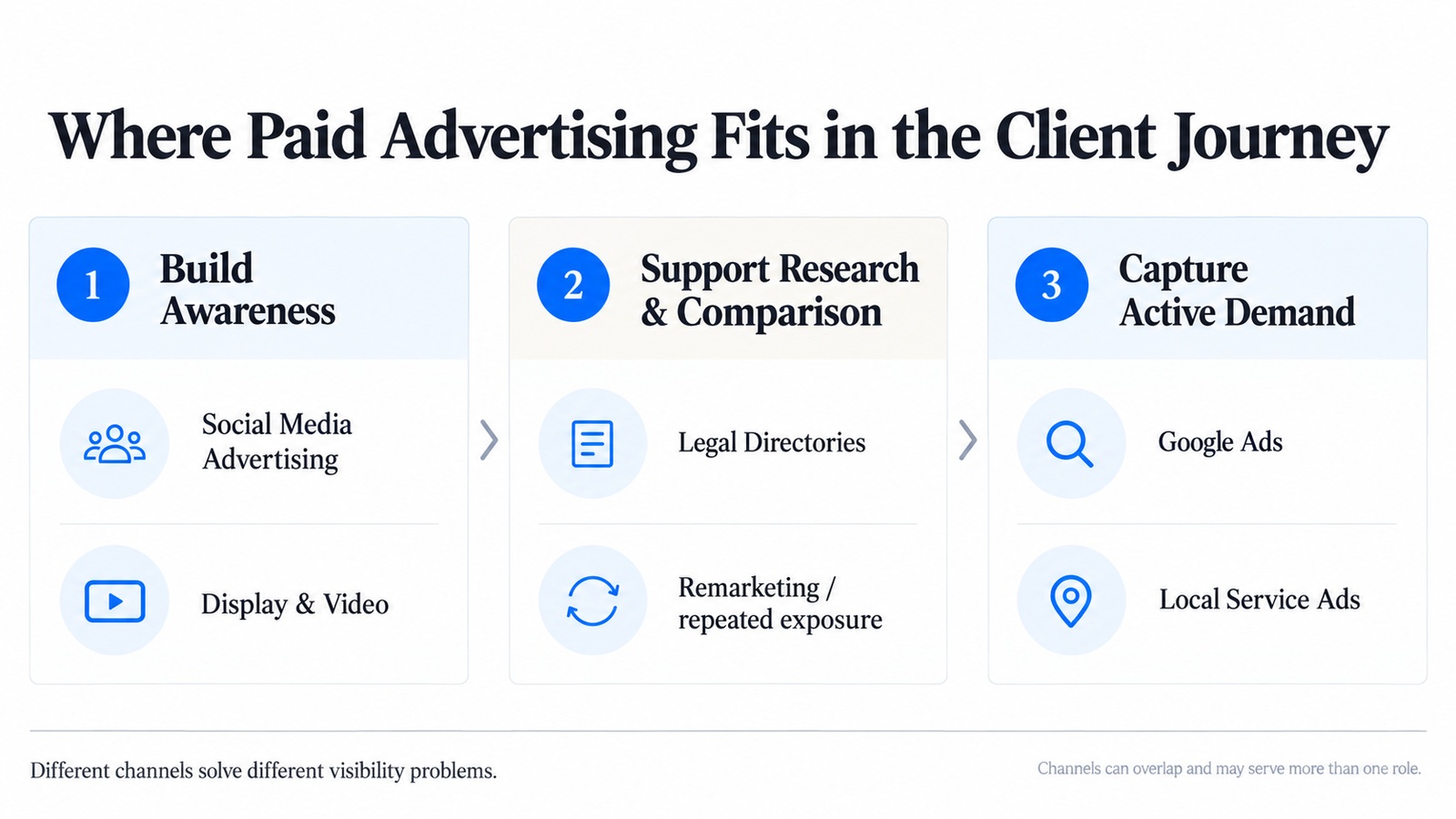
Law firms can pay for visibility through search engines, local search, social media, video platforms, and legal directories. The right channel depends on the firm's goals and how people typically look for that kind of legal help.
Some channels reach people actively searching for an attorney. Others work better for awareness, remarketing, repeat exposure, or more targeted audiences.
Google Ads
Google Ads puts law firms in front of people actively searching for attorneys, legal services, or information tied to a case type.
Search intent and precise targeting make Google Ads for law firms a major part of legal PPC.
Best fit: Competitive markets, specific practice areas, and searches with clear legal intent.
Local Service Ads
Local Service Ads give eligible law firms another prominent placement when people search locally for legal help.
Depending on the practice area and market, an LSA may include:
- Firm and contact information
- Reviews and reputation signals
- Screening or verification information
- Direct call or contact options
- Lead-based rather than click-based billing
Best fit: Local client acquisition in eligible legal categories and service areas.
Social Media Advertising
Social media is part of a law firm's online real estate. Prospective clients may look for a firm on Facebook, Instagram, LinkedIn, or other platforms before making contact, and a credible presence helps reinforce that the business is active and legitimate.
It does not have to run the firm's marketing strategy to be useful. Paid social can support awareness, remarketing, recruiting, or targeted campaigns, while a broader social media marketing strategy maintains the organic presence prospective clients expect to find.
Best fit: Awareness, brand visibility, remarketing, recruiting, and defined audiences.
Display & Video Advertising
Display and video advertising help law firms stay visible outside traditional search results.
Display ads: Appear across websites and apps, often for awareness, remarketing, and repeated exposure.
Video ads: Run on YouTube and other platforms, giving firms more room to explain a message, build recognition, or stay memorable.
Firms using video across paid media, social platforms, and their own websites may also invest in commercial video production to create those assets.
Best fit: Brand visibility, remarketing, and campaigns that benefit from repeated exposure.
Paid Legal Directories
Legal directories and profile-based platforms such as Avvo and FindLaw may sell enhanced listings, sponsored placement, leads, or other paid visibility.
A firm's presence on those platforms can still matter without a paid product. Profiles may support visibility, citations, reputation, and link building, while paid directory products add another layer of exposure or lead generation.
Best fit: Firms comparing profile visibility, paid placement, and third-party leads.
Should Law Firms Advertise Every Practice Area?
Should they? Probably not. The ability to buy visibility for a legal service does not automatically make it a good place to spend money.
Different practice areas have different economics.
A personal injury law campaign may face very different costs, competition, and case values than one for corporate and business law.
Organic performance matters too.
Some services already generate steady organic leads. Others attract harder-to-qualify inquiries, carry lower case values, or cost too much to advertise profitably in a particular market.
Location changes the math.
A campaign that works for one office, service area, or case type may perform very differently somewhere else.
Paid advertising works best when it solves a specific business problem. That might mean entering a competitive market, generating more of a valuable case type, supporting a newer practice area, or building visibility while organic marketing gains traction. The goal is to direct paid visibility toward opportunities worth pursuing.
The Economics Behind Paid Advertising for Law Firms
Legal advertising gets expensive quickly in competitive practice areas and major markets. Campaign cost depends on much more than the price of a single click.
-
Competition
More firms and lead-generation companies bidding for the same attention push costs up. -
Click or Lead Cost
Some searches and lead sources simply cost more than others. -
Potential Case Value
Higher-value matters may support higher acquisition costs. -
Lead Quality
Cheap traffic is not useful if it produces poor-fit matters or people outside the firm's market. -
Search Demand
Some practice areas and locations generate far more search activity than others. -
Conversion Rate
A firm can afford to spend more when more clicks and leads become consultations or retained matters.
An expensive click is not automatically a bad investment. What matters is how acquisition cost compares with lead quality, conversion rate, and potential case value. Together, those factors determine what paid advertising costs for law firms in practice.
What Should Attorneys Know Before Paying for PPC?
PPC isn't a vending machine that lets you select E7 and get a high-value case in a specific county. Before deciding what a click or lead is worth, a few realities matter.
-
You May Be Competing With Firms You've Never Heard Of
Your PPC competitors are not necessarily the firms you think of as your biggest competitors. A newer practice, national advertiser, referral operation, or firm focused heavily on one case type may be willing to spend more for the same opportunity.
-
Not Every Advertiser Plans to Keep the Case
Some firms advertise for matters they expect to refer elsewhere. If the referral economics work, they may bid aggressively without intending to handle the case themselves.
-
The Cheapest Click Is Not Automatically the Best Click
Low-cost searches may look efficient in a campaign report, but price says very little about the person behind the click, the quality of the inquiry, or the potential value of the matter.
-
More Leads Can Still Be a Bad Result
Calls and form submissions mean little when they come from the wrong case types, people outside the firm's service area, or matters the attorneys do not want.
-
Paid Advertising Needs Active Management
Budgets, competitors, targeting, search behavior, and bidding systems change over time. A campaign that performs well today can drift into wasted spend when nobody watches where the money goes and what comes back.
What Comes After the Click?
Buying traffic is only one part of the system. Landing pages, tracking, lead quality, and intake determine what happens next.
For law firms, paid advertising works best as a managed investment, not a switch that gets turned on and forgotten.