

Making Paid Advertising Work for Law Firms
Part 2, Chapter 1: From Ad Clicks to Qualified Clients
Table of contents
Someone searches for a DWI attorney, clicks a law firm's ad, and lands on a generic homepage. The firm handles DWI cases, but the visitor has to dig through the website to find that information. The campaign paid for a relevant click without giving the person a clear next step.
Making paid advertising work requires more than reaching the right audience. Landing pages, ad messaging, conversion tracking, and client intake all influence what happens after someone clicks. A well-targeted campaign can still waste money when that path breaks down.
Key Takeaways
- The ad itself is only one part of the conversion path.
- A landing page should continue the promise made by the ad and give visitors a clear next step.
- Lead quality matters more than raw click or form volume.
- Weak tracking or intake can waste traffic that was otherwise worth paying for.
What Should Happen After Someone Clicks a Legal Ad?
Someone who clicks an ad for a specific legal problem should not have to figure out if the firm handles it, hunt for contact information, or work through a generic page that barely relates to the ad.
A good campaign keeps the path clear:
1. The Ad Matches the Search or Situation
The ad should reflect what the person is actually looking for. If the message attracts people outside the intended case type, the firm may be paying for attention it never wanted.
2. The Destination Continues the Same Message
The landing page should confirm that the visitor is in the right place. An ad for a specific legal service should lead to content about that service, not a generic homepage or unrelated practice-area page.
Google Quality Score: Google uses Quality Score as a diagnostic for expected clickthrough rate, ad relevance, and landing-page experience. Those factors help show how well the ad and destination match what the user searched for. Quality Score is useful for identifying weak spots, but the score itself is not an auction input.
3. The Next Step Is Obvious
Once someone sees that the firm may be able to help, the next action should be easy to find. That might include:
- Calling the firm
- Submitting a contact form
- Requesting a consultation
- Starting a case-specific intake form
4. Intake Does Not Create Unnecessary Friction
A good click can still die during intake. Long forms, missed calls, slow follow-up, irrelevant questions, or a poor handoff to intake staff can waste traffic the campaign already paid to earn.
5. The Firm Can Evaluate the Result
Activity alone does not make a campaign successful. The firm needs to connect advertising to useful outcomes such as qualified calls, consultations, retained clients, and matters worth acquiring.
What Is Worth Advertising for a Law Firm?
Not every legal service deserves the same advertising budget. Paid campaigns make the most sense when the firm has a clear reason to compete for the traffic and a realistic path from the ad to a valuable case.
Good candidates for paid advertising often include:
- High-value case types: Matters where one retained client can justify a meaningful acquisition cost.
- Services the firm actively wants more of: Practice areas the firm has the capacity and experience to handle.
- Competitive searches with clear intent: People looking for a specific attorney, legal service, or urgent type of help may be closer to taking action. Google Ads are especially useful for reaching that kind of active search demand.
- Markets where organic visibility is limited: Paid ads can create visibility while SEO, local search, or other channels take longer to develop.
- Time-sensitive opportunities: Campaigns tied to changing demand, deadlines, events, or short-term business priorities.
Advertising is less useful when the firm does not want the cases, cannot respond effectively to the leads, or has no clear way to judge what a successful result is worth.
Cheap Does Not Mean Worth Advertising
A low-cost keyword or audience is not automatically a good opportunity. Some firms deliberately advertise around less expensive cases they can refer out, but the real question is whether the traffic supports the firm's business goals.
Good vs. Bad PPC Landing Pages
WHEN THE LANDING PAGE WORKS
Good PPC Landing Page
- Matches the ad and case type
- Makes the firm's relevance clear quickly
- Uses proof related to the campaign
- Provides an obvious next step
- Works well on mobile
- Helps qualify useful leads
THE NIGHTMARE SCENARIO
Bad PPC Landing Page
- Sends everyone to the same generic page
- Makes visitors hunt for the advertised service
- Uses vague or unrelated claims
- Hides the contact path
- Creates technical or intake friction
- Generates activity without useful leads
What Makes an Effective Legal Landing Page?
A good landing page should make the visitor feel like the ad brought them to the right place. It does not need to explain everything the firm does. It needs to answer the questions created by that specific ad.
The Legal Service Should Be Clear Quickly
The visitor should be able to tell what the firm handles without digging through several paragraphs. Useful information may include:
- The legal issue or case type
- The clients the firm represents
- The geographic area or jurisdiction served
- Common situations that may lead someone to seek help
The Firm Should Show Why It Fits the Case
The page should give visitors enough information to understand why the firm is relevant to the problem being advertised. Case results, reviews, attorney experience, jurisdictions served, and other proof are most useful when they support that specific campaign.
The Conversion Path Should Match Intent
Legal needs create very different levels of urgency and readiness.
- Urgent situations: Immediate legal problems may call for a prominent phone number and a fast response.
- Comparing firms: People weighing their options may spend more time reviewing attorney experience, case results, testimonials, or other proof.
- Early research: Less certain prospects may want more context before they are ready to contact the firm.
- Ready to hire: High-intent traffic needs a direct consultation or intake path with as little friction as possible.
The Page Should Work Well on Mobile
Many legal searches happen on phones. Slow loading, buried information, or difficult forms can lose leads even when the ad itself is doing its job.
The landing page is part of the campaign itself. The ad creates an expectation; the page has to carry it forward.
What Happens After the Landing Page?
A landing page is not the end of the campaign. Paid advertising still depends on what happens next: how quickly the firm responds, how leads are screened, and whether advertising can be connected to real business outcomes.
The process usually looks something like this:
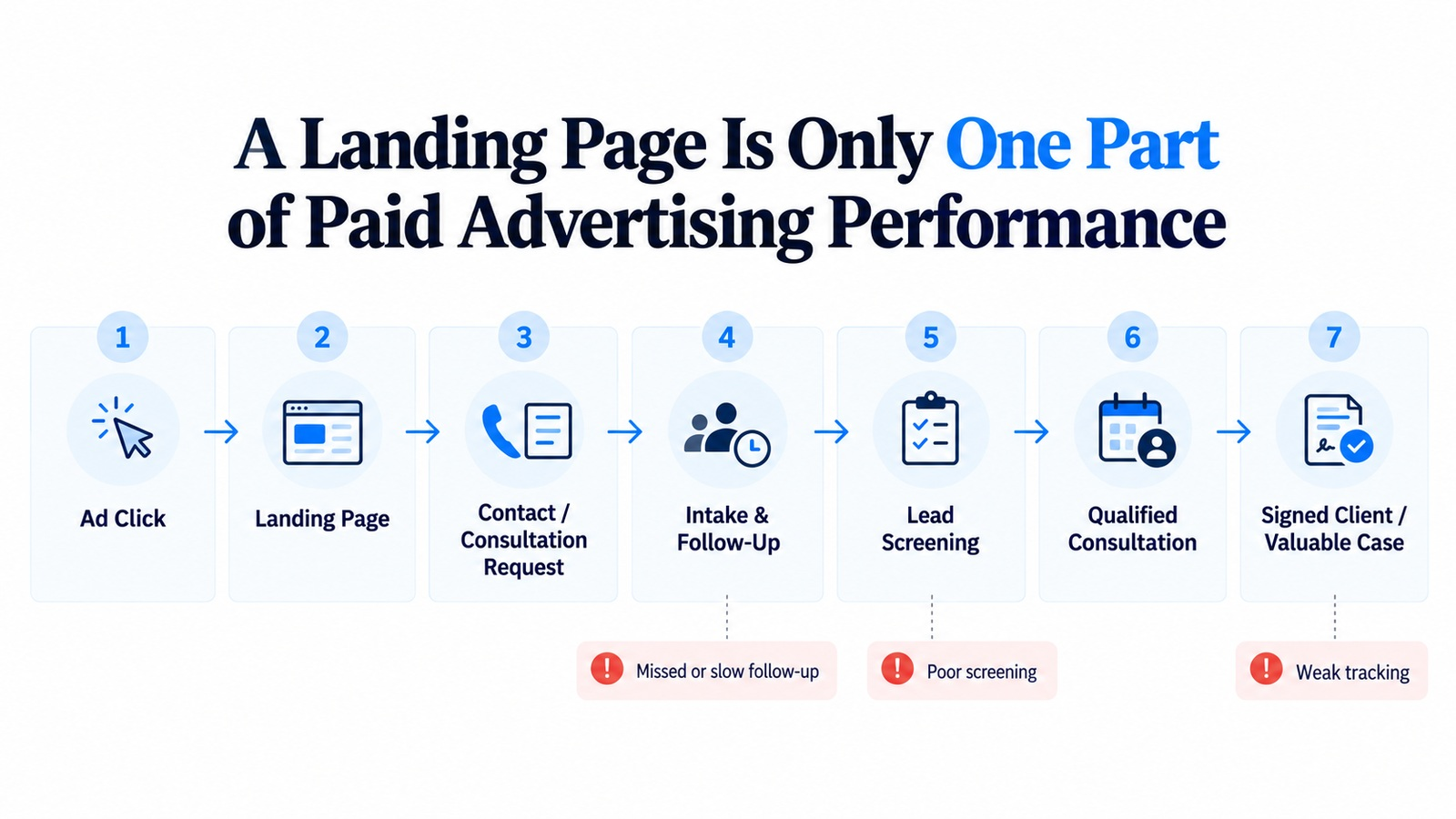
Follow-up still affects performance.
A good click and a strong landing page can still go to waste if calls are missed, forms sit too long, or nobody responds while the lead is still active.
Screening helps define lead quality.
Not every inquiry is a good fit. The firm still needs to identify the right case types, jurisdictions, and client needs so paid traffic does not turn into expensive noise.
Tracking should go beyond the lead.
Clicks, calls, and form submissions only tell part of the story. A better view connects paid advertising to qualified leads, consultations, retained clients, and case value.
Pros & Cons of Multiple PPC Landing Pages
Separate landing pages can make paid campaigns more relevant, but every additional page also creates something else to maintain, measure, and improve. The goal is not to create a new landing page for every ad. Important campaigns need enough separation to stay relevant without creating more pages than the firm can reasonably maintain.
| Advantages | Tradeoffs |
|---|---|
| Better message matching: Different campaigns can have their own message, proof, and conversion path. | More maintenance: Every additional page needs to stay accurate and current. |
| More relevant proof: Case results, reviews, and attorney experience can match the legal service being advertised. | More tracking: More landing pages create more conversion paths and performance data to monitor. |
| Better audience fit: Pages can account for geography, client needs, and different levels of intent. | More duplication risk: Too many pages can become nearly identical and difficult to distinguish. |
| Cleaner testing: Changes to one campaign do not have to affect every source of paid traffic. | More coordination: Service, attorney, offer, or intake changes may need updates across several pages. |
Should PPC Landing Pages Change Over Time?
A PPC landing page is part of an active campaign, not something that gets published once and left alone forever. Performance data and intake experience can both reveal when the page is attracting the wrong people, creating confusion, or failing to move qualified leads forward.
Use Poor-Fit Leads as a Signal
Repeated calls from the wrong jurisdiction, inquiries about services the firm does not handle, or leads that consistently fail to qualify may point to a problem with targeting, ad messaging, or the landing page itself.
Feed Intake Experience Back Into the Page
Campaign data can show what people clicked and which actions they took, but intake staff and attorneys often notice patterns the analytics do not explain. Those patterns can help identify what the page should clarify, emphasize, or change.
Landing-page updates should respond to what the campaign is actually producing, rather than changing the page for the sake of changing it. Updates may include:
- Clarifying the legal services or case types the firm wants to attract
- Removing or revising content that brings in poor-fit leads
- Adding relevant case results, testimonials, or other proof
- Improving calls to action or intake options
- Reworking sections that create confusion or fail to move people forward
- Adjusting the page as the firm's markets, services, or priorities change
Landing Page FAQs
Q: Should every PPC ad have its own landing page?
A: Not necessarily. A dedicated landing page makes sense when a campaign needs a focused message, a specific case type, or a different conversion path. A relevant existing practice-area page can also work if it matches the ad and gives people a clear next step.
Q: Can a law firm send paid traffic to its homepage?
A: It can, but a homepage is often too broad for a specific ad. The destination should clearly reflect the legal service, case type, or problem that caused the click.
Q: Can intake problems waste otherwise useful paid traffic?
A: Yes. Missed calls, slow follow-up, confusing forms, or poor screening can waste otherwise useful paid traffic. The campaign does not end at the landing page.
Q: How should a law firm judge whether a landing page is working?
A: Look beyond clicks and form submissions. A useful landing page should help produce qualified inquiries, consultations, and retained matters that fit the firm's goals.
Q: Should PPC landing pages be updated over time?
A: Yes. Lead quality, intake feedback, campaign data, and changes in the firm's services or priorities may show where the page needs clarification or improvement.