

Keyword Research & Search Intent for Law Firms
Part 1, Chapter 1: Keyword Research & Search Intent
Table of contents
If you're paying for SEO, you've probably heard plenty about keywords. Maybe your firm wants to rank for car accident lawyer. But choosing a phrase to target is only one part of deciding which searches are worth your attention.
Keyword research identifies what people search for. Search intent explains why they're searching. Someone typing car accident lawyer may be ready to hire an attorney. Someone asking what should I do after a car accident? might need answers before making that decision. Both searches could lead to a client, but they represent different needs and opportunities for your firm.
Key Takeaways
- Popular keywords aren't necessarily valuable keywords. Search volume alone doesn't tell a firm which searches will attract potential clients.
- Search intent explains what someone wants to accomplish, not just the words they type into Google.
- People don't always describe legal problems the same way attorneys describe their practice areas or case types.
- Keyword priorities should reflect the firm's business goals, target markets, and the cases it wants to handle.
How Do Search Engines Understand Legal Searches?
Search engines interpret legal searches using the words in a query, related concepts, search intent, and geographic context. They don't rely on exact keyword matches alone.
Words & Related Concepts
People don't always know the legal terminology for their problems. Search engines can connect everyday language with related legal subjects.
- My boss won't pay me overtime → Wage and hour laws
- My landlord won't fix the heat → Landlord-tenant law
Search Intent
Searches about the same legal issue can reflect different needs. Some people want information, while others are looking for representation.
- How to respond to an eviction notice → Seeking information
- Eviction defense attorney near me → Looking for legal representation
Location & Jurisdiction
Search engines can use a person's location to interpret searches with geographic or legal relevance. The same phrase may produce different results depending on where someone searches, even without naming a city or state.
- First offense drunk driving searched from St. Louis → Results may emphasize Missouri DWI laws
- First offense drunk driving searched from Chicago → Results may emphasize Illinois DUI laws
What Makes a Keyword Relevant to a Law Firm?
A relevant keyword connects to a legal problem the firm handles and a potential client it can help. A search phrase might attract thousands of visitors but offer little value if it falls outside the firm's practice areas, geographic reach, or business goals.
For a criminal defense law firm, relevant searches can extend far beyond criminal defense lawyer. People may search for:
Broad Legal Services: Criminal defense attorney, DWI lawyer, felony defense lawyer
Specific Charges & Situations: First-time DWI, drug possession charges, probation violations
Legal Questions & Statutes: Penalties for a second DWI, what happens after an arrest, or the specific statute cited in someone's charging documents
Not every keyword variation or statute needs its own page. A useful explanation of a legal issue can address several related searches without repeating the same information across multiple pages.
Short-Tail vs. Long-Tail Keywords
Short-tail keywords are broad search phrases, such as criminal defense lawyer or divorce attorney. They often attract more searches but face greater competition and represent a wider range of client needs.
Long-tail keywords are more specific searches, such as lawyer for second DWI in Missouri or dividing a family business during divorce. They may attract fewer searches but reveal more about someone's legal problem and the services they need.
Both deserve consideration. Long-tail keywords aren't always literally longer, and specificity doesn't automatically make a keyword more valuable. What matters is how closely the search matches the firm's services and goals.
Why Informational Searches Can Lead to Clients
Not every valuable search produces an immediate phone call. A useful answer may introduce someone to a firm before they're ready to seek representation.
The First Search
A person Googles the statute number on their charging documents. A defense firm's website explains the charge, possible penalties, and legal options.
The Later Decision
After researching their situation, the person decides to speak with an attorney. The firm whose website answered their earlier questions is already familiar.
Pages explaining charges and legal questions can also point readers toward related defense services. We'll cover how to build connected, relevant legal content in a later chapter.
What Keywords Should Your Law Firm Target?
A legal keyword is worth targeting when it supports the firm's business goals and justifies the effort required to compete for it. Search volume matters, but popularity alone doesn't determine which keywords deserve attention.
When evaluating keyword opportunities, law firms should consider four things:
- Case Value & Fit: Does the search relate to work the firm wants and is qualified to handle? A phrase can generate substantial traffic without attracting the kinds of cases the firm needs.
- Search Intent: Is someone looking for an attorney, comparing their options, or trying to understand a legal problem? These distinctions also matter in AI search, where people may ask longer, more conversational questions.
- Search Volume: How often do people search for the phrase? Keyword research tools provide estimates, but lower-volume searches shouldn't automatically be dismissed if they represent valuable legal needs.
- Competition: Which websites already appear for the search, and how difficult might it be to compete? Ranking alongside established firms and major legal directories may require considerable time and effort.
High Search Volume Doesn't Always Mean High Value
Consider a family law firm that wants to attract more complex divorce cases involving business ownership. Two related searches could offer very different opportunities.
Broad Keyword
"Divorce Lawyer"
Potential Reach: A broad audience searching for divorce representation.
Search Intent: Interest in hiring an attorney, but with widely varying case types and needs.
Business Fit: Relevant to the firm's overall services, but not specifically focused on complex divorce cases.
Specific Keyword
"Dividing a Business in Divorce"
Potential Reach: A narrower audience researching a particular legal issue.
Search Intent: Understanding how business ownership and assets may be handled during divorce.
Business Fit: Closely aligned with the complex cases the firm wants to attract.
Neither keyword is automatically the better investment. The broader search may reach more potential clients, while the specific search may attract people facing the exact issues the firm handles. Search demand, competition, and the firm's priorities should determine where the effort goes.
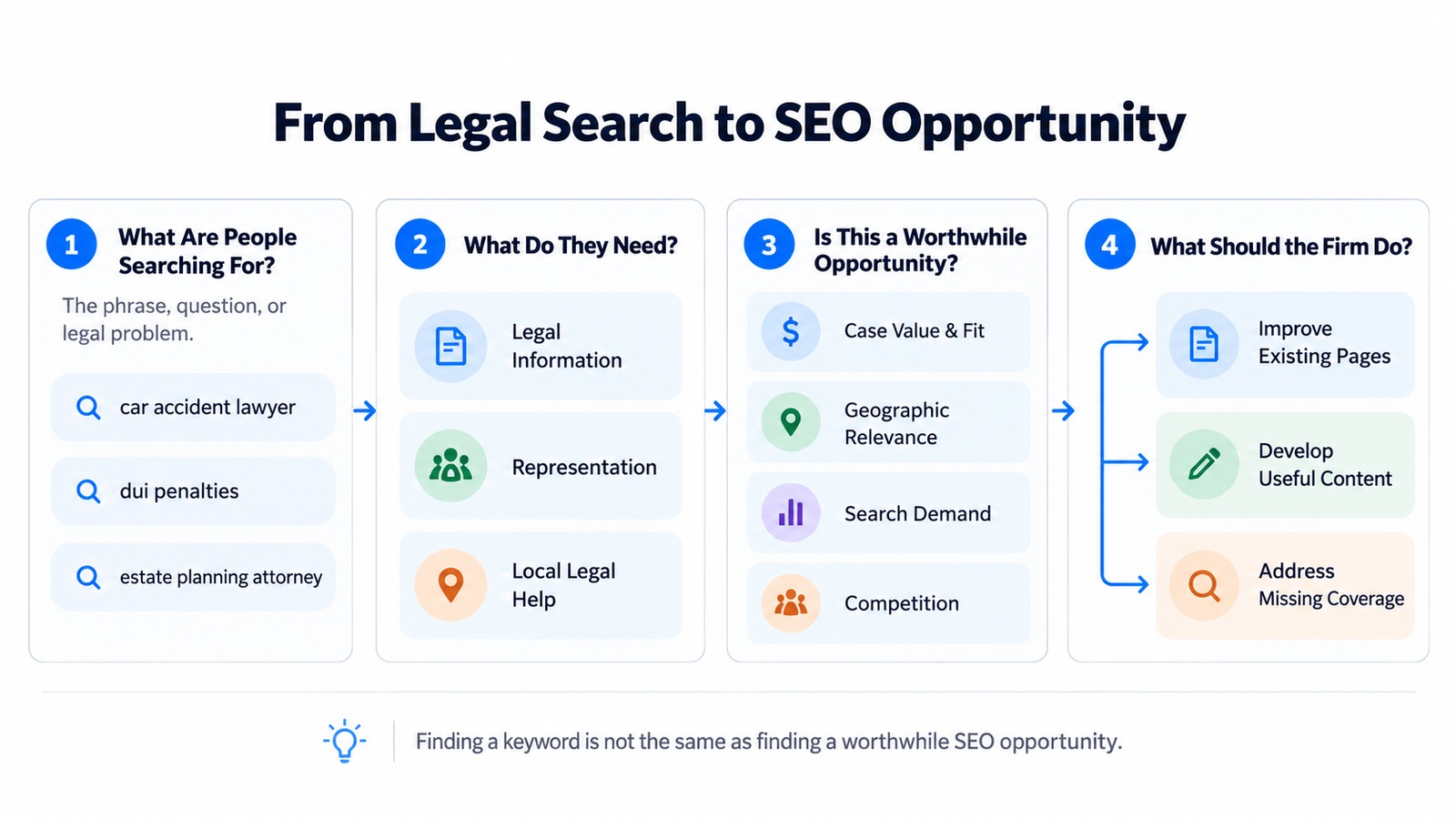
Finding Useful Legal Keywords
Keyword research starts with understanding what potential clients need, then uses search data to investigate how they look for help. Several sources can reveal worthwhile searches that a firm's website may not yet address.
● Client Questions & Conversations
Consultations, intake calls, and everyday client questions can reveal legal problems worth researching. The way someone describes a problem may be very different from the language an attorney uses.
For example: A client asks, "Can I clear an old conviction from my record?" That gives the firm a reason to investigate how people search for expungement information, eligibility, and legal help.
● Existing Website & Search Data
If the firm has Google Search Console set up, it can see which search queries its pages appeared for in Google results. Impressions, clicks, and average position help identify existing visibility and opportunities for improvement.
Google Analytics 4 (GA4) adds information about organic visitors and what they do on the website. It can help track changes in traffic and visitor behavior following website updates, including technical SEO improvements, but doesn't reveal the specific keywords behind most visits.
● Keyword Research Tools & Search Engines
SEO tools help investigate search phrases, estimate demand, and examine competition. Useful resources include:
- Ahrefs: Keyword suggestions, search volume estimates, and competitor research
- Semrush: Related searches, search intent, and keyword difficulty estimates
- Moz: Keyword suggestions, search demand, and competition metrics
- Search Engines: Manual searches on Google and Bing can reveal suggested queries, related searches, and the pages already appearing for a topic
● Competitor Websites & Sitemaps
Other law firms may already have pages addressing cases, charges, or legal questions your website overlooks. Their practice-area pages, FAQs, and supporting articles can provide research ideas.
A competitor's publicly available XML sitemap can reveal more of its website's pages, including subjects that aren't prominent in its navigation. These sitemaps are simply lists of website URLs provided for search engines. They can help identify content worth investigating, although they don't show which pages are actually performing well.
What Do You Do With Those Keywords?
Finding useful keywords is only the beginning. A law firm still needs to decide how to put that research to work on its website.
01. Improve Existing Pages
Research may reveal better ways to describe the firm's services or important questions missing from an existing page. It can also inform page titles, headings, and URLs.
02. Develop Articles & FAQs
Searches about specific charges, legal procedures, or common problems can inspire blog posts and answers that help potential clients.
03. Identify Missing Subjects
Research may uncover relevant case types or legal services that the website barely addresses, helping the firm decide where additional coverage makes sense.
A law firm may already handle exactly the cases people are searching for and still have very little on its website that speaks to those searches. Keyword research can expose that disconnect. Addressing it means deciding which pages belong on the website, how they're organized, and how people find their way between them.