

SEO for Law Firms
Part 1: A Practical Guide to Organic Search
Table of contents
Search engine optimization (SEO) helps law firms appear in organic search results rather than paid advertisements when people look for legal help online. Some searchers are ready to hire an attorney. Others are still trying to understand a legal problem.
But getting found isn't the same as attracting the right clients. SEO should support the work a firm actually wants, and modern search demands more than keyword repetition or old-school SEO strategies.
*We've included a quick reference to SEO terms near the bottom of this page.
Key Takeaways
- SEO should support the firm's business goals. Higher rankings and more traffic matter less than attracting potential clients for the cases a firm wants to handle.
- Search intent and website structure work together. Understanding what people search for helps firms decide which pages to build, how to organize them, and where to direct visitors.
- Good content needs a functional website. Accurate legal information, credible attorney expertise, technical accessibility, and usable contact options all contribute to effective SEO.
- AI search changes how people discover legal information. Traditional SEO remains relevant, but visibility may extend beyond website visits and conventional search rankings.
Why Do Search Engines Care About Quality?
Google is a business, and search is one of its most important products. People return because they expect useful answers to their questions. If search results become unreliable or unhelpful, people have fewer reasons to keep using them.
Search quality is part of the business model.
Google earns substantial advertising revenue from the people using its services. Maintaining trust in search results supports continued use of the platform and the business built around it.
In the legal industry, people may be making decisions about their rights, finances, or future. They need information they can trust, which makes the quality of a firm's legal content more important than the number of pages it publishes.
How Google Ranks Law Firms
A law firm won't hold the same position in every search result. Rankings vary depending on what someone searches for, their location, and the competition for that particular search.
A firm competing against a handful of smaller local practices faces a different challenge than one trying to outrank established firms in a major market. Existing visibility, content, and reputation all influence how difficult it may be to compete.
What effective law firm SEO needs to address:
✓ Search relevance: Matching legal information to the questions and needs behind a search.
✓ Content quality: Providing useful answers that reflect the firm's actual services and legal knowledge.
✓ Website organization: Making important information easy to find and showing how related pages connect.
✓ Technical accessibility: Helping search engines find and process pages while keeping the website usable for visitors.
✓ Authority & credibility: Demonstrating relevant experience and earning recognition from trustworthy outside sources.
✓ Geographic relevance: Connecting the firm's legal services to the markets and jurisdictions where it practices.
What SEO Does for Law Firms
SEO helps law firms attract potential clients, build visibility for the legal services they offer, and generate inquiries for the cases they want to handle. The priorities depend on the firm's business goals, experience, and existing presence in search results.
New Personal Injury Firm
Establish Search Visibility
An experienced injury attorney leaves a larger practice to open a new firm. The attorney may have an established reputation and referral network, but the new website has little search visibility.
- Build visibility for personal injury searches in the firm's target market
- Attract consultation requests beyond existing referrals and professional contacts
Established Personal Injury Firm
Attract More Complex Cases
An established injury firm receives steady car accident inquiries but wants to expand into serious injury claims and commercial truck accident cases.
- Increase visibility for the specific injury cases the firm wants to handle
- Track qualified inquiries by case type rather than overall traffic or call volume
How People Search for Legal Help
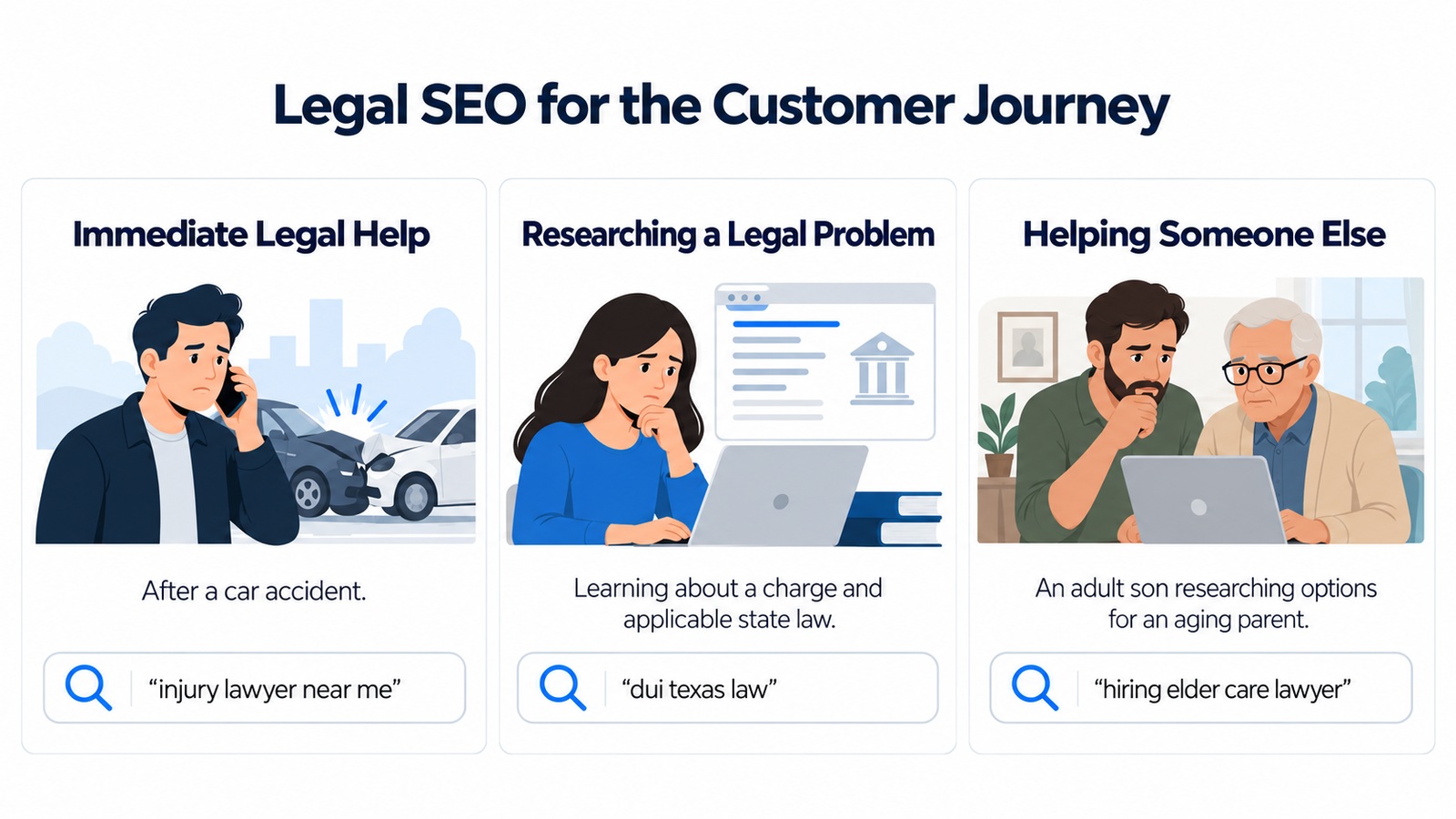
People search for legal help for different reasons. Some need an attorney immediately, others are researching a legal problem, and some are looking for representation on behalf of someone else. Their circumstances shape what they search for and how quickly they need answers.
Immediate Legal Help
After a car accident, an injured driver searches for a nearby attorney and needs a quick way to make contact.
Researching a Specific Problem
A person facing criminal charges researches the exact charge and applicable state laws before deciding how to proceed.
Looking for Help for Someone Else
An adult child searches for an elder law attorney to help a parent plan for long-term care.
Effective SEO gives people a useful next step. That might be a clear answer to a legal question or a simple way to contact an attorney. As people increasingly turn to AI search for legal information, those answers also need to be useful beyond traditional search listings.
Questions Law Firms Should Ask About SEO
Q: I'm already paying for SEO. What am I actually paying for?
A: You should be paying for work intended to improve your firm's search visibility and attract relevant potential clients. Depending on the strategy, that may include content development, link building, website improvements, or fixing technical SEO problems. Your agency should be able to explain what's included, what's being prioritized, and why.
Q: How much does SEO cost for a law firm?
A: SEO costs depend on the firm's goals, competition, and scope of work. For real-world examples, Hexxen's marketing packages include:
- Foundation: $1,250–$1,850/month, plus a $3,500 setup fee
- Competitive: $2,250–$3,500/month, plus a $5,000 setup fee
- Industry Leader: Custom programs starting at $5,000+/month
These packages include SEO alongside other marketing services. They aren't SEO-only prices or quotes specifically for law firms.
Q: How do we know our SEO is working?
A: Track organic search traffic, phone calls, contact form submissions, and qualified inquiries. Where possible, connect those inquiries to specific practice areas and website pages to see which services attract potential clients. Search rankings and traffic show visibility, but the number and quality of relevant inquiries provide a better measure of SEO's business value.
Q: What should our law firm focus on for SEO?
A: Start with the practice areas, case types, and geographic markets your firm wants to prioritize. Review where your website already attracts relevant visitors and where important services lack visibility. Those findings can guide decisions about website organization, content development, and ongoing SEO investments. Focus on opportunities that support the firm's business goals rather than chasing every available keyword.
Q: When should we rethink our SEO strategy?
A: Revisit the strategy when results consistently fall short of your firm's goals or its business priorities change. Publishing more pages and building more links isn't necessarily the answer. Sometimes the problem is what you're targeting, how resources are being spent, or what happens after someone reaches your website.
Next: Keyword Research & Search Intent for Law Firms
QUICK REFERENCE
SEO Terms You'll See in This Guide
- SERP: Search engine results page. The page showing organic listings, ads, and other search features.
- Organic Result: A search listing that isn't a paid advertisement.
- Keyword: A word or phrase someone uses to search for information, services, or answers online.
- Short-Tail Keyword: A broad search phrase, such as "divorce lawyer," that may attract more searches but faces wider competition.
- Long-Tail Keyword: A more specific search phrase, such as "dividing a business during divorce," that reflects a narrower legal need.
- Search Intent: What a person wants to find, learn, or accomplish through a search.
- Search Visibility: How prominently and frequently a website appears for relevant searches.
- Crawling: When a search engine discovers and accesses website pages.
- Indexing: When a search engine processes and stores information about a page for possible use in search results.
- Backlink: A link from another website pointing to your website.
- Conversion: A useful visitor action, such as calling the firm or submitting an inquiry.
RELATED RESOURCE
Outdated & Risky SEO Strategies for Law Firms
Some of these tactics were once standard SEO advice. Others were questionable from the beginning. If your firm is still using them exactly as described, maybe call your probate lawyer (unless you already are one).
Not every outdated tactic is black-hat SEO. Some older, generally acceptable ("white-hat") practices simply stopped being useful. Others use manipulative methods that violate search engine spam policies. Here's what changed and why these strategies deserve a second look.
Keyword Stuffing
Repeating target keywords unnaturally throughout a page to make them appear more important.
What changed: Search engines understand related concepts and search intent. Repeating the same phrase doesn't automatically make a page more relevant.
Hidden Text
Adding keyword-heavy text that visitors couldn't easily see, such as matching text to the background.
What changed: Hiding content to manipulate rankings violates Google's spam policies. Legitimate interactive content, such as tabs, is a different matter.
Meta Keyword Abuse
Adding lists of target search phrases to a page's meta keywords tag in hopes of improving rankings.
What changed: Google no longer uses the meta keywords tag as a ranking signal for web searches. Adding more keywords to it accomplishes nothing.
Doorway & Thin Location Pages
Creating nearly identical pages for dozens of cities or keyword variations, often with little more than the location name changed.
What changed: Legitimate location pages still have value. Mass-produced doorway pages that add little useful information can violate search spam policies.
Article Spinning
Publishing multiple versions of essentially the same article by swapping words or automatically rewriting passages.
What changed: Rewording existing content doesn't create new value. Producing large amounts of unoriginal content primarily to manipulate rankings can violate spam policies.
Mass Directory Submissions
Submitting the firm to hundreds of directories primarily to accumulate backlinks.
What changed: Relevant directories still support discovery and credibility. Large numbers of low-quality listings offer little value simply because they contain a link.
Link Schemes
Buying backlinks, trading links at scale, or creating artificial linking networks to manipulate rankings.
What changed: Google's link spam policies target manipulative linking practices. The source and purpose of a link matter more than simply increasing the total count.
Exact-Match Everything
Forcing the same target phrase into headings, URLs, anchor text, and repeated website elements.
What changed: Exact phrases still have their place, but repeating them everywhere isn't a shortcut to relevance.
Keyword Density Targets
Writing toward a specific percentage of keyword mentions instead of explaining the subject naturally.
What changed: There is no universal keyword percentage that makes a page rank. Relevance depends on much more than repetition.
Writing for Crawlers
Producing awkward content around supposed search-engine rules instead of writing for actual readers.
What changed: Search engines aim to surface useful information. Content written primarily to manipulate an algorithm often misses what the searcher actually needs.