

AI Search for Law Firms
Part 1, Chapter 5: AI Search for Law Firms
Table of contents
Someone researching a legal problem might now get an answer from Google or ChatGPT without visiting a law firm's website. AI-generated responses can cite legal resources, mention specific attorneys, and influence which firms people research next.
AI search creates new opportunities for law firms to be discovered, but it doesn't replace traditional SEO. Accurate legal content, credible attorney expertise, and a reliable presence beyond the firm's website remain important. Those foundations are worth maintaining regardless of which platform someone uses to research legal help.
Key Takeaways
- AI visibility doesn't always mean website traffic. A law firm may appear in an AI-generated answer without receiving a direct website visit. Rankings and traffic alone won't tell the whole story.
- Your firm's reputation extends beyond its website. Accurate legal content, attorney credentials, and reliable information from outside sources all contribute to how a firm is represented and evaluated.
- AI search builds on existing SEO efforts. Law firms don't need a separate content strategy for every new platform. Useful legal information, technical accessibility, and a credible online presence support traditional search and AI-assisted discovery.
How Does AI Search Handle Legal Questions?
AI search can answer legal questions using information from multiple sources rather than simply presenting a list of websites. Depending on the platform, responses may draw on trained knowledge, retrieve current information, or cite specific legal resources.
Looking for Information
Researching a Legal Question
"What happens when someone dies without a will in Missouri?"
An AI response might summarize inheritance rules, explain probate, and reference legal resources. Accurate legal guides and educational content provide useful information for this type of research.
Looking for Representation
Finding a Legal Professional
"Who handles probate cases in St. Louis?"
Now the person is looking for an attorney. AI responses may identify law firms or individual lawyers using information from their websites, professional profiles, directories, and other publicly available sources.
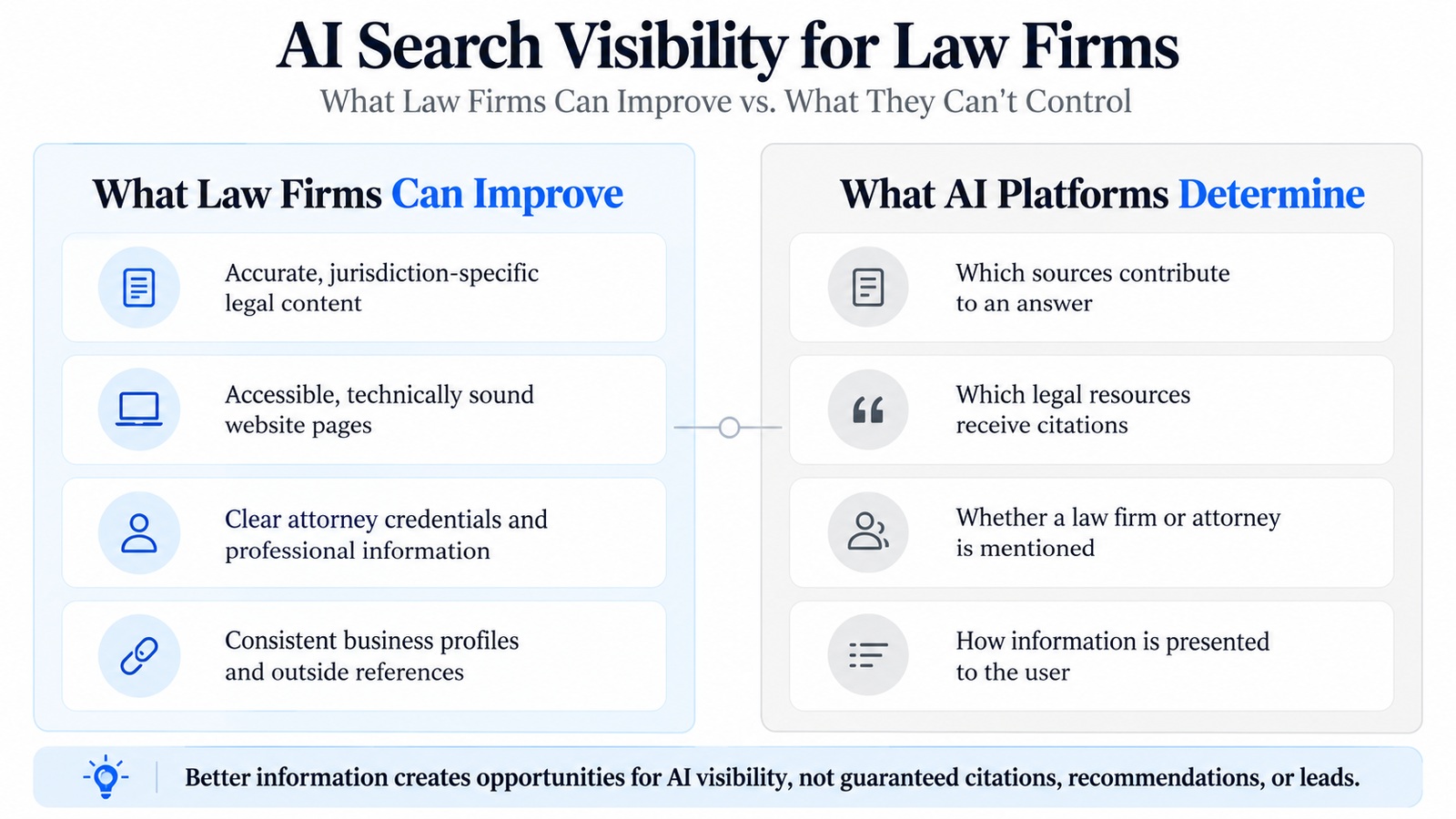
Same legal subject, different search intent. AI systems can draw from multiple sources to answer both kinds of questions, but their responses aren't always reliable. They may overlook legal exceptions, confuse jurisdictions, or rely on outdated laws. Law firms can't control what AI platforms say, but they can publish accurate information supported by credible sources.
But Not Every Legal Search Is That Straightforward
People don't always know what kind of attorney they need or how to describe their situation. Real searches can get a lot messier:
"hey grok, got rear-ended yesterday and i'm fine but do i actually need a lawyer"
"best legal lawyer near me"
"my boss fired me after i complained about missing overtime... can he do that"
"dad died in illinois but owned a house in missouri, what do we do"
"do i need a divorce lawyer or someone who handles custody stuff"
"already signed something from the insurance company, did i screw myself"
"ok but what if it happened in another state"
Some questions are vague. Others contain personal circumstances or build on an earlier conversation. AI tools can use that context to help people narrow down what they're looking for. Someone might begin by describing a problem and eventually ask for an attorney without ever using a conventional legal search phrase.
Where Does AI Search Get Information About Law Firms?
A law firm's website isn't the only place AI systems may encounter information about its attorneys and services. Professional profiles, independent sources, and public records can provide additional information about the firm. That makes the accuracy of its broader online presence worth attention.
Several types of sources can contribute to AI-generated legal answers and information about attorneys:
| Information Source | What It Contributes |
|---|---|
| The Firm's Website | Practice-area pages, attorney biographies, and legal content provide information about the firm's services, experience, and legal knowledge. |
| Professional Profiles & Directories | Bar association listings, attorney profiles, and legal directories provide additional information about credentials, practice areas, and professional identity. |
| Reviews & Outside Mentions | Public reviews, news coverage, and other independent references contribute information about the firm's reputation and public presence. |
| Legal & Government Resources | Court websites, statutes, government publications, and other legal references provide information that AI systems may use when addressing questions about laws or legal procedures. |
Not every AI platform uses these sources in the same way, and appearing on a particular website doesn't guarantee an AI citation or recommendation. For law firms, the practical concern is having accurate, consistent information available wherever prospective clients and search systems might encounter it.
What Makes AI Search Choose Its Sources?
There isn't one universal ranking formula for AI-generated answers. Platforms use different methods to retrieve and present information. But when an AI search system looks for material to support an answer, several practical considerations come into play.
1. Can It Find and Access the Page?
Information blocked from search crawlers or missing from relevant indexes has fewer opportunities to appear in retrieved results. The same technical SEO principles we've already discussed still matter.
2. Does It Actually Answer the Question?
A detailed explanation of Missouri probate requirements offers more relevant information for an inheritance question than a generic page promoting a firm's experience. Understanding search intent helps firms publish content that addresses what people really want to know.
3. Is the Information Credible and Verifiable?
Accurate legal explanations, identifiable attorneys, current references, and supporting sources make information easier to evaluate. A firm should be able to substantiate its claims, particularly when discussing legal rights or procedures.
Google's AI search guidance reinforces the importance of established SEO practices. For Google's AI search features, accessible pages and useful, reliable information still matter. No special AI-specific optimization is required to be eligible for inclusion.
Does Your Law Firm Show Up?
Ask the same legal question on a few different platforms. Compare the answers, sources, and law firms mentioned.
Google AI Search | ChatGPT | Gemini | Perplexity | Copilot | Claude | Grok
Giving AI Search Something Worth Referencing
AI search already has access to plenty of general legal information. A law firm adds more value when its content provides the details that make an answer accurate, useful, and specific to the situation.
This is where traditional SEO and Generative Experience Optimization (GEO) overlap: Publishing information readers can understand and search systems can identify, interpret, and potentially reference.
Consider a law firm writing about unpaid overtime. Here's how its content could go beyond a general explanation:
Identify the Rule and Where It Applies
Instead of vaguely stating that federal law protects workers from unpaid overtime, the guide could identify 29 U.S.C. § 207, part of the Fair Labor Standards Act. It generally requires overtime compensation for covered, nonexempt employees who work more than 40 hours in a workweek.
Explain What Changes the Answer
Not every employee falls under the same overtime rules. Exemptions, job responsibilities, state law, and other circumstances may change the analysis. Explaining those distinctions gives readers a better way to recognize which facts matter before assuming a violation occurred.
Connect the Explanation to Verifiable Authority
The article could reference the U.S. Department of Labor's overtime guidance, applicable court decisions, or other relevant legal authorities.
The attorney then adds context those sources may not provide on their own: which facts commonly create disputes, where exceptions arise, and when a situation deserves closer legal review.
The goal isn't to scatter legal citations throughout a page hoping an AI platform notices. It's to explain the law accurately and provide useful context around those citations.
Setting Realistic Expectations for AI Search
AI search creates opportunities, not guaranteed placements. A law firm might appear in one AI-generated answer and be absent from another. Results vary between platforms and questions, and no marketing agency can promise consistent citations or recommendations.
It's also worth distinguishing between optimizing a website for AI search and using AI tools to perform marketing work. They serve different purposes.
| The Work | What to Expect |
|---|---|
| AI Search Optimization | Improving legal content, clarifying attorney credentials, and maintaining accurate information across the web give AI search systems better material to work with. That doesn't automatically mean adding more content for SEO. The focus should be on improving the information already available and addressing meaningful gaps. |
| Using AI for Marketing | AI tools can accelerate research, drafting, content planning, and data analysis. But using AI to write and market a website still requires direction. Producing work faster doesn't make it accurate or effective. Marketing strategy, editorial judgment, and professional legal review remain necessary. |
How Should Law Firms Evaluate AI Search Results?
- Look Beyond One AI Answer: Test relevant legal questions across platforms and track changes in brand mentions and cited sources over time. Firms can track visibility in AI search, but individual responses shouldn't be treated like permanent search rankings.
- Consider the Business Impact: AI visibility doesn't always produce direct website traffic. Referral activity, qualified inquiries, and client feedback can help determine if prospective clients are discovering the firm through AI-assisted research.
- Understand What You're Paying For: An agency should be able to explain what information it's improving, how progress is monitored, and which outcomes remain outside its control. A promise to "get your firm into ChatGPT" isn't a meaningful marketing plan.