

Google Business Profile for Law Firms
Part 3, Chapter 1: Managing Your Law Firm's Presence on Google
Table of contents
Google your law firm. Chances are, your Google Business Profile (GBP) is one of the first things you see. It's got your office location, phone number, reviews, and other details people use to check out your practice. And it's not just there for people who already know your name.
For law firms competing in local search, Google Business Profile is a big deal. Your profile influences how your firm appears in Google Search and Maps when people look for attorneys in your area. Managing it properly helps prospective clients find your practice and decide whether to contact you.
Key Takeaways
- Google Business Profile is central to local visibility. It connects your firm to Google Search and Maps.
- Accurate business information matters. Categories, office details, and contact information need regular attention.
- Law firms have unique listing considerations. Multiple offices and individual attorney profiles require careful management.
- Reviews and ongoing management matter. Client feedback, current information, and an actively maintained profile help prospective clients evaluate your firm.
What Does Your Law Firm's Google Business Profile Actually Do?
Your Google Business Profile does more than display contact information. It connects your practice with prospective clients through Google Search and Maps, supporting local visibility and helping people evaluate your firm.
Supports Your Firm's Local Search Visibility
Your GBP connects your firm to Google Search and Maps, making it an important part of local search marketing for law firms. Prospective clients searching for legal services in your area encounter business profiles alongside other search results.
Provides a Central Source of Business Information
Your GBP is considerably more useful than an old Yellow Pages listing. It provides a central reference for your firm's location, contact information, office hours, and other details prospective clients need to find and contact the right office.
Builds Trust Before Someone Contacts Your Firm
Prospective clients use more than a business name and phone number to evaluate attorneys. Your GBP gives people additional information about the practice, supporting the credibility signals discussed in our chapter on AI search for law firms.
Reviews: Public feedback about clients' experiences with the firm
Photography: Actual office locations, attorneys, and staff that help people recognize the practice
Business Details: Current hours, contact information, and other signs that the firm maintains an active presence
Helps Protect Your Firm's Brand and Identity
Claiming and managing your GBP gives your firm greater oversight of its identity on Google, including incorrect information and listings that confuse your practice with another business. That responsibility extends to attorney profiles, legal directories, and paid legal directory placements that influence how prospective clients recognize your firm.
Claiming & Verifying Your GBP
Established law firms may already have a Google Business Profile, even if nobody at the firm remembers creating or claiming it. Newer practices may need to create one from scratch. Either way, the first step is determining whether an existing listing represents your firm and who controls it.
How the Process Usually Works
- Find or create your firm's listing. Search Google or Maps using your practice name and location. If a profile already exists, work with that listing rather than creating a duplicate. If not, create a new profile for your eligible office.
- Claim or request access. Claim an existing unverified listing or request ownership from the current account holder when necessary. Your firm should retain primary ownership, even when an outside marketing agency manages the profile.
- Complete Google's verification process. Follow the verification method Google provides, which might involve video, phone, email, or another available option. Use the verification instructions for the method assigned to your firm.
Why GBP Claiming & Verification Sometimes Go Wrong
That process sounds straightforward. It isn't always. Google has to establish that the person requesting control is authorized to represent a real business at an eligible location.
- Unknown ownership: A former employee, agency, or attorney still controls the listing.
- Duplicate profiles: Multiple listings represent the same firm or office, creating conflicting business information.
- Verification failures: Google rejects a verification attempt because the submitted evidence doesn't adequately establish the firm's location or management.
- Office eligibility: Virtual offices, shared spaces, and locations without appropriate staffing or signage create problems under Google's business listing rules.
- Suspensions or reverification: Google restricts a profile or requests additional proof after changes to the business information.
Why Does Google Make Verification So Difficult?
Google probably isn't trying to make claiming and managing your GBP unnecessarily difficult. These safeguards exist largely because business profiles are valuable targets for scammers, impersonators, and other bad actors looking to exploit their visibility and credibility. Unfortunately, legitimate businesses get caught up in the process, too.
Before submitting questionable information, changing an address to get around a verification problem, or creating another listing, stop and get help. Even a seemingly minor mistake can turn a frustrating verification process into a much larger problem.
Optimizing Your Law Firm's GBP
GBP optimization starts with accurate business information, not tricks to manipulate rankings. A complete profile helps Google understand your practice and gives prospective clients useful details about your services, locations, and contact options. It's an important part of your firm's broader digital marketing strategy.
Get Your Name, Address & Phone Number Right
Your firm's name, address, and phone number (NAP) form the foundation of its business information. These details should accurately represent the practice and match what's published on your website and other important listings. Existing citations with accurate NAP information can also provide supporting evidence of the firm's identity and location during verification, although they don't replace Google's required verification steps. Following Google's Business Profile guidelines also helps avoid problems with eligibility and verification.
- Business name: Use the name your firm actually operates under. If clients know you as Smith Law Firm, LLC, and that's the name on your signage and business materials, use it. Don't turn it into "Smith Law Firm LLC – Best Personal Injury Lawyers in Chicago" to chase rankings.
- Office address: Use your firm's actual, eligible office location and check that the map pin identifies the correct building and entrance.
- Phone number: Use a reliable business number that connects prospective clients with your firm.
- Website: Link to the appropriate firm website or location page, rather than sending visitors somewhere unrelated to the listing.
Choose the Right Business Categories & Legal Services
Your GBP's primary business category is one of its most important local ranking considerations. Google has more than 4,000 business categories, and choosing the right one matters. A firm specializing in criminal defense shouldn't automatically settle for a broad category like "Law Firm" when a more specific, accurate category is available.
Google allows one primary category and up to nine additional categories, but that doesn't mean your firm should use all ten. Choose the fewest categories that accurately represent your practice, using Google's business category guidance to make those decisions.
For example, a firm primarily handling criminal defense that also takes family law and personal injury cases might select:
- Primary category: Criminal Justice Attorney
- Additional category: Family Law Attorney
- Additional category: Personal Injury Attorney
These categories describe the practice, while services identify the specific legal work it performs. A criminal defense firm might list DUI defense, drug charges, and federal criminal defense as services. This helps prospective clients understand what the firm actually handles.
Add Useful Photos & Business Details
Prospective clients want to know they're contacting a real practice. Your GBP gives them a way to recognize the firm, see where they'll be visiting, and understand what to expect before making contact.
Exterior Photos: Show the actual building, entrance, and signage. A photo of the entrance is especially helpful when the office is inside a larger building or professional complex.
Office & Team Photos: Use real images of the reception area, meeting spaces, attorneys, and staff. Skip generic courthouse stock photography that tells prospective clients nothing about your practice.
Business Description: Explain the firm's practice areas, experience, and geographic reach in ordinary language. For example, a criminal defense firm could mention DWI defense, felony charges, and the counties where its attorneys regularly practice.
Office Hours & Contact Options: List accurate customer-facing hours and make it easy to reach the firm. If the intake team answers calls after the office closes, don't confuse telephone availability with physical office hours.
Keep Your Profile Updated After Optimization
Your law firm's GBP is a living business document. Google changes its features and how business information appears, while your own practice evolves. Maintaining the profile deserves as much attention as setting it up correctly.
Business Changes → Profile Updates
A new attorney, office move, revised hours, or expanded practice area should be reflected in the information prospective clients find on Google.
Profile Updates → Ongoing Monitoring
Check that changes appear correctly, watch for inaccurate suggested edits, and review how people interact with your listing.
Ongoing Monitoring → Better Business Information
Use what you find to keep photos, descriptions, services, and contact details relevant to the practice as it operates today.
Because Google also receives business information from other sources, review your listing for unexpected changes. Alongside responding appropriately to reviews, make updating your Business Profile information part of your firm's normal operations.
Managing Google Reviews on Your Law Firm's GBP
Google reviews appear alongside your law firm's Business Profile in Search and Maps, helping prospective clients evaluate your practice before contacting you. Client feedback also provides useful material for your website. Featuring genuine reviews and testimonials within your law firm website gives visitors another way to evaluate the practice.
- Request genuine reviews: Share your firm's Google review link with clients when appropriate. Don't offer incentives, pressure clients to leave positive feedback, or selectively request reviews based on expected ratings. Follow Google's review policies and applicable legal advertising rules.
- Respond professionally: Thank reviewers when appropriate and address negative feedback without arguing publicly. Never confirm an attorney-client relationship, disclose case details, or reveal confidential information in a response.
- Report policy violations: Fake reviews, spam, and other prohibited content may qualify for removal through Google's review reporting process. A negative review isn't automatically a policy violation, and reporting doesn't guarantee removal.
- Monitor reviews regularly: Check for new feedback, flag suspicious activity, and establish who at the firm is responsible for reviewing and approving public responses.
Beyond Google: Your Law Firm's Online Reputation
Your firm's reputation extends beyond its Google Business Profile. Legal directories, other review platforms, and the way your practice handles client feedback all contribute to its public image. Part 3, Chapter 3 covers law firm reviews and reputation in greater detail.
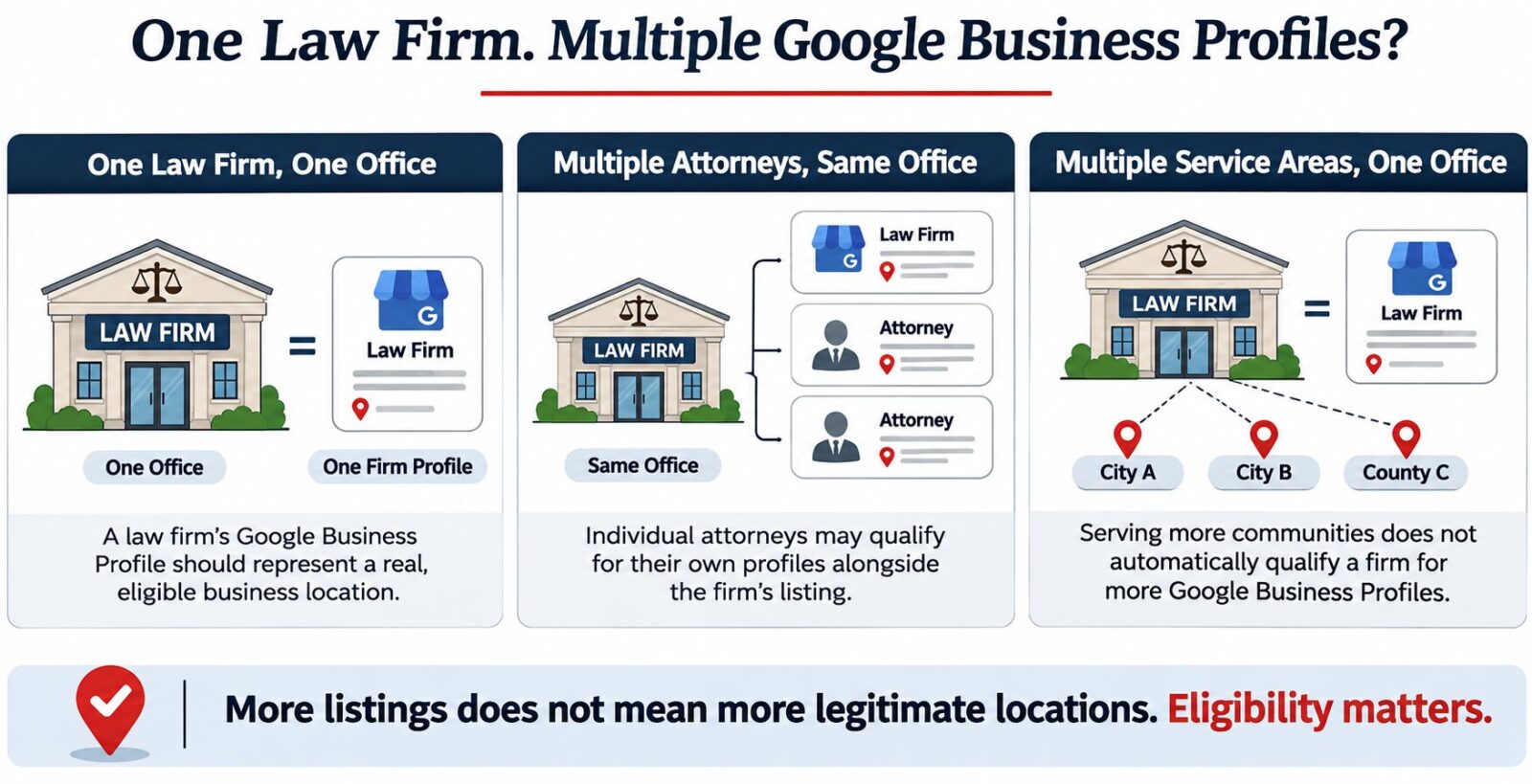
Attorney Profiles, Office Locations & GBP Eligibility
Google allows eligible individual attorneys to maintain Business Profiles alongside their firm's listing. For law firms with several attorneys or offices, understanding which profiles qualify helps avoid duplicates and other listing problems.
For example, a firm with two attorneys working at the same office might have:
- Smith & Jones Law Firm: The firm's profile for its physical office.
- Jane Smith, Attorney: An individual profile for an eligible attorney who works directly with clients.
- Robert Jones, Attorney: A separate profile for another eligible attorney at the same location.
Individual attorney profiles must represent eligible practitioners, and separate office listings require legitimate business locations. A firm serving five counties doesn't automatically qualify for five GBPs. Virtual mailing addresses, duplicate listings, and separate profiles for individual practice areas aren't shortcuts to greater local visibility.
Be careful when restructuring existing profiles. Merging, removing, or separating listings can affect established reviews and local visibility. Reviews don't automatically transfer between profiles, and recovering them isn't guaranteed. These considerations become especially important when planning multi-location SEO for law firms.
Measuring Your Google Business Profile's Performance
Start by searching for your law firm on Google and Maps. Does your Business Profile appear with accurate information? Then try searches for your practice areas in the markets you serve. These results offer a starting point for evaluating local visibility, although rankings vary by the searcher's location and other factors.
Google Business Profile also provides performance data to help you track:
- Search visibility: How people find your profile and how often they view it.
- Calls and website clicks: How often people use your listing to contact or research your firm.
- Direction requests: How often people request directions to your office.
Compare these trends over time, then look at your actual inquiries. Are people calling about relevant cases? Are website visitors requesting consultations? A GBP that attracts qualified prospective clients is more valuable than one generating views without meaningful business activity.
Making Google Business Profile Work for Your Law Firm
A well-managed Google Business Profile supports your firm's local presence alongside its website and broader marketing efforts. Accurate information, relevant categories, genuine reviews, and regular maintenance help prospective clients find your practice and determine if it handles their legal needs. The ultimate goal is to turn that visibility into meaningful inquiries.