

Law Firm Reviews & Reputation
Part 3, Chapter 3: Building Trust Through Client Reviews & Reputation
Table of contents
Online reviews can influence where a law firm appears in local search and which listing a prospective client chooses. Star ratings, review volume, and client experiences help people compare attorneys before making contact. Reviews can also inform AI-generated recommendations, extending their influence beyond traditional search results.
But reviews aren't just marketing signals. They're direct feedback about how clients experience your firm. Positive reviews reveal what people appreciate, while criticism can identify problems that deserve attention. Both matter long after someone clicks a search result.
Key Takeaways
- Reviews influence local search visibility. Ratings, review volume, and client feedback can affect how prospective clients discover and compare law firms.
- Reputation matters beyond Google. Legal directories, attorney profiles, and AI-powered search can influence how people evaluate your firm.
- Client feedback has business value. Reviews reveal what clients appreciate and where your firm may need to improve.
- Legal reviews require professional care. Requesting and responding to feedback involves client confidentiality, advertising rules, and ethical considerations.
How Reviews Influence Local Search & Client Decisions
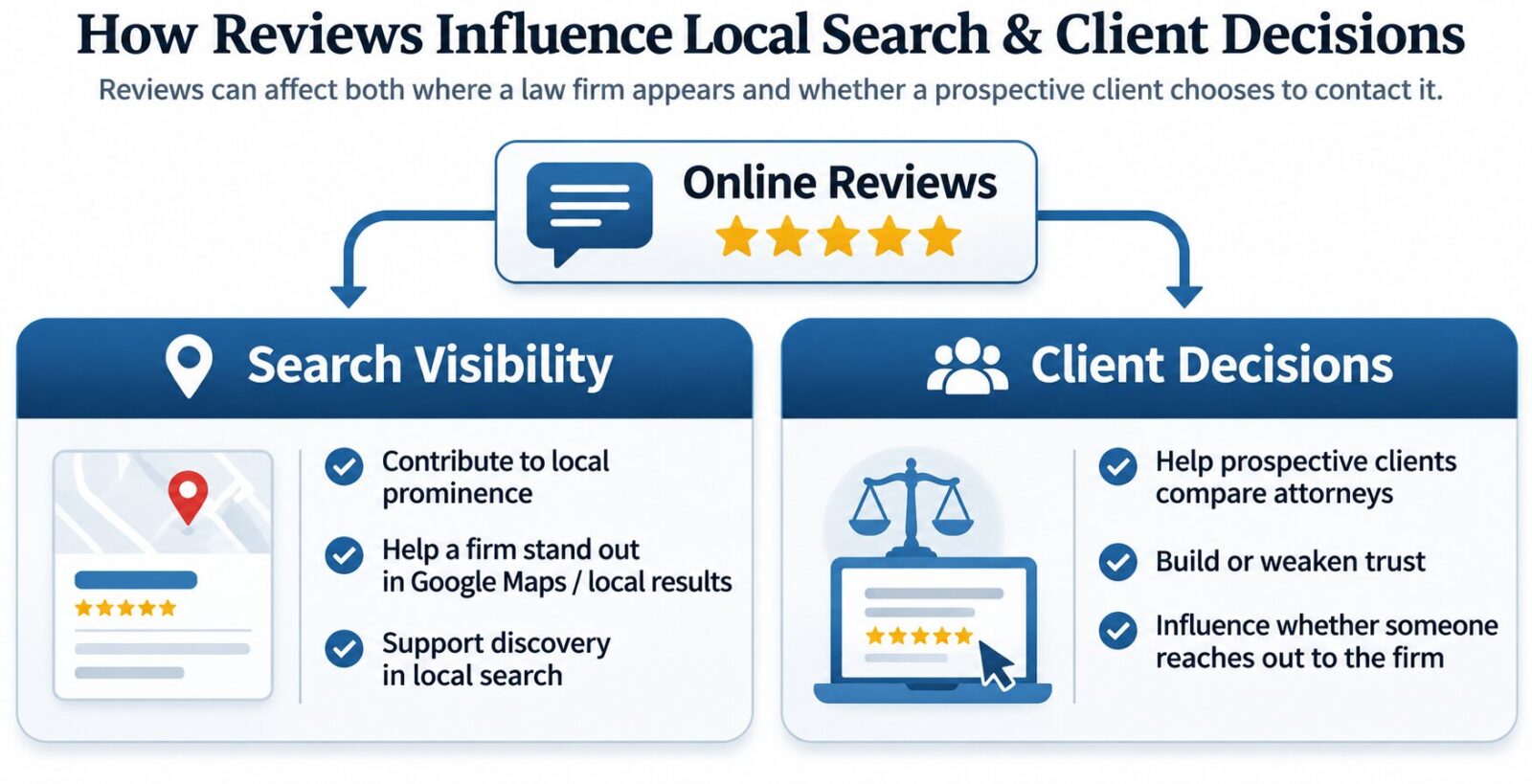
A prospective client searching for an attorney may see several law firms offering similar services in the same area. Reviews help distinguish those options before the person visits a website or makes a call.
1. Search visibility: Reviews can influence how prominently a law firm appears in local search results, particularly Google Maps.
2. Client confidence: Ratings and written feedback help prospective clients compare firms and decide which attorneys deserve their trust.
Why Prospective Clients Pay Attention
A high star rating can catch someone's eye, but the number and substance of reviews provide important context. Consider two law firms appearing in the same search results:
HIGH RATING, LIMITED FEEDBACK
4.9 Stars | 3 Reviews
- Strong first impression: A near-perfect rating immediately stands out among competing listings.
- Limited perspective: Three reviews provide relatively little information about the firm's consistency or broader client experience.
- More questions: Prospective clients may look elsewhere for additional feedback before making contact.
MORE REVIEWS, MORE CONTEXT
4.6 Stars | 150 Reviews
- Broader perspective: More reviews give prospective clients a larger sample of experiences to consider.
- Useful details: Written feedback may describe communication, professionalism, responsiveness, and client service.
- Recognizable patterns: Repeated praise or criticism can reveal strengths and concerns that a star rating alone cannot explain.
Neither rating tells the whole story. Prospective clients may look for recurring comments about whether an attorney listens, explains complicated matters clearly, returns calls, and treats people respectfully. Those details offer perspectives that a law firm's own marketing cannot provide in quite the same way.
Reviews that seem unusually vague, exaggerated, or repetitive can also raise suspicions about authenticity, regardless of the firm's overall rating.
Different Types of Reviews & Client Feedback
Not all reviews communicate the same information. Some give prospective clients a quick impression of a law firm's reputation, while others provide detailed accounts of what working with its attorneys is like. Firms can benefit from several forms of feedback, each serving a different purpose.
Google Reviews & Star Ratings
Google Business Profile reviews are among the most visible forms of client feedback, particularly when someone compares attorneys through Google Maps or local search results. They offer several immediate signals:
- Average rating: A quick impression of overall client satisfaction.
- Review volume: How much public feedback supports that rating.
- Written experiences: Details about communication, responsiveness, and the client relationship.
- Recency: Whether people continue to share experiences with the firm.
Legal Directory & Third-Party Reviews
Reviews on legal directories and other independent platforms can add context beyond a firm's Google profile. Prospective clients may encounter feedback while researching individual attorneys, practice areas, or firms they are already considering.
Platforms such as Avvo and Justia also provide attorney profiles and professional information. Their review and rating features vary, so firms should distinguish actual client feedback from platform-generated ratings or other credentials.
Written & Video Testimonials
Testimonials allow firms to feature client experiences in their own marketing, including website pages, videos, and other promotional materials. They can provide more personal context than a star rating alone.
- Written testimonials: Highlight specific experiences, concerns, or qualities clients appreciated.
- Video testimonials: Let prospective clients hear someone describe their experience directly, potentially making the feedback more relatable.
Case Studies & Client Success Stories
Case studies go beyond a client's opinion to explain a legal challenge, the firm's approach, and an outcome. As a form of law firm website content, they can help prospective clients understand the kinds of matters a firm handles and how its experience relates to their needs.
Unlike independent reviews, case studies are typically produced by the firm. They require particular care with client confidentiality, permissions, accurate descriptions of results, and advertising rules governing expectations about future outcomes, including ABA Model Rule 7.1. State-specific rules also apply.
These formats are not interchangeable. Independent reviews reflect feedback published through third-party platforms, while testimonials and case studies are generally selected or prepared for marketing. A strong reputation draws on credible public feedback and thoughtful use of client experiences rather than relying on any single format.
Do Reviews Affect Search & AI Visibility?
Online reviews can influence a law firm's visibility in Google local search results and contribute to how AI-powered search systems describe or recommend businesses. Their impact depends on the platform, the quality and consistency of feedback, and other factors beyond reviews alone.
Google Local Search
Reviews contribute to how Google evaluates a law firm's local prominence. According to Google's local ranking guidance, local search results depend primarily on three factors:
- Relevance: How closely the firm's Business Profile matches what someone is searching for.
- Distance: How far the firm is from the location associated with the search.
- Prominence: How well-known the firm is, including signals such as reviews, ratings, links, and other online information.
Reviews support the work of local SEO rather than replace it. Search visibility puts a law firm in front of prospective clients. Ratings and client feedback help determine whether those people choose to click, visit, or call.
AI Search & Recommendations
Reviews don't guarantee rankings or placement in AI-generated answers, but they're an important part of an AI search strategy for law firms. Platforms such as Grok, Gemini, and ChatGPT answer questions, compare options, and help users make decisions. When someone asks for a recommended attorney, publicly available reviews can provide useful evidence for that answer.
For example, someone researching legal representation might ask an AI assistant:
"Which personal injury lawyers in St. Louis have good reviews?"
An AI-generated response might compare firms using ratings, client feedback, practice areas, and other publicly available information.
"What do clients say about this divorce attorney?"
An AI system might summarize recurring comments about communication, responsiveness, and clients' experiences with the attorney.
"Is this law firm reputable?"
The response might consider review history alongside attorney credentials, professional profiles, and information from independent sources.
AI-generated recommendations may draw on reviews alongside information from legal directories, law firm websites, and other public sources. Reviews help establish a firm's reputation, but they don't independently determine which attorneys an AI system recommends.
What Law Firms Should Do With Their Reviews
Collecting positive reviews is valuable, but leaving them scattered across Google and legal directories limits their usefulness. Law firms can incorporate genuine client feedback into their websites, marketing materials, and broader reputation strategy.
01. Feature Reviews on Relevant Website Pages
Your firm's website structure should make room for testimonials on relevant practice-area pages, attorney profiles, and other pages where client feedback adds context. Place reviews where they support the surrounding content rather than relying exclusively on a separate testimonials page.
02. Repurpose Reviews Across Marketing Channels
With appropriate permission, genuine client feedback can support social media posts, testimonial graphics, videos, and other promotional materials. Preserve the original meaning of each review and avoid edits that exaggerate results or create misleading expectations.
03. Maintain Accurate Reviews & Profiles Across Platforms
Review your firm's presence across Google, attorney profiles, and legal directories and paid lead platforms to identify outdated information, inconsistent profile details, or missing feedback. Distinguish genuine client reviews from editorial ratings or platform-generated scores.
04. Use Review Structured Data Appropriately
As part of technical SEO for law firms, review-related structured data can help search engines understand eligible content, but it doesn't guarantee enhanced search appearances. Google's rules generally exclude self-serving reviews of a business displayed on its own website from review rich results. Markup isn't a shortcut to displaying stars in organic search.
05. Use Feedback to Improve Client Experiences
Look for recurring comments about communication, billing, responsiveness, and professionalism. Consistent praise can reveal what your firm does well, while repeated criticism may identify processes that need attention. Better client experiences can lead to stronger reviews over time.
How Do Law Firms Get More Client Reviews?
The best way to get more client reviews is to make leaving one easy. Even satisfied clients may never think to share feedback unless someone asks. Law firms should make review requests a natural part of client communication, not an awkward sales pitch or another administrative chore.
- Ask at the right time: Make a respectful request when the opportunity naturally arises, such as during a follow-up conversation or after concluding a matter.
- Provide a direct link: Google Business Profile lets firms share a review link or QR code. Send it by text or email so clients don't have to search for the firm's listing.
- Make it routine: Incorporate review requests into existing client follow-ups. Automated messages can help, but personal communication and good judgment matter more than collecting reviews on a schedule.
Don't offer incentives, pressure clients, or selectively ask only those likely to leave positive feedback. These practices can violate Google's review policies. Attorneys must also consider confidentiality and applicable professional conduct rules when requesting public reviews.
Handling Negative Reviews & Reputation Risks
Negative reviews don't automatically damage a law firm's reputation, but responding poorly can make matters worse. Firms should evaluate criticism carefully, distinguish legitimate concerns from misleading or fraudulent feedback, and consider whether a public response is appropriate.
Respond Professionally & Protect Confidentiality
Keep public responses brief, courteous, and focused on addressing concerns without discussing specific legal matters. Never reveal confidential information or confirm a client relationship simply to defend the firm. When appropriate, invite the reviewer to continue the conversation privately.
Address Legitimate Problems & Report False Reviews
Recurring complaints may reveal issues worth correcting internally. For reviews that violate platform policies, such as spam, impersonation, or fabricated experiences, use the platform's reporting process rather than engaging in a public argument. An unfavorable opinion alone generally isn't grounds for removal.
Reputation management isn't about eliminating every negative review. It's about responding responsibly, protecting clients, and addressing problems that could affect future relationships.
Law Firm Reviews & Reputation FAQs
Q: Can a law firm remove a negative Google review?
A: Law firms can report reviews that violate Google's policies, including spam, impersonation, and certain forms of abusive content. However, Google generally won't remove a review simply because it's negative or the firm disagrees with it. Reporting a review doesn't guarantee removal.
Q: Can law firms buy Google reviews?
A: No. Buying reviews, paying for positive ratings, or using fake client accounts violates Google's review policies. These practices can expose law firms to several consequences:
- Google penalties: Review removal, restrictions on receiving new reviews, or public warnings on the firm's Business Profile.
- Regulatory consequences: Potential action under consumer protection laws governing deceptive reviews and testimonials.
- Professional conduct violations: Misleading testimonials may violate attorney advertising rules and create disciplinary risks.
- Lost credibility: Suspicious or fabricated feedback can undermine the trust that genuine reviews are supposed to build.
Law firms should build their reputations through genuine, voluntary client feedback rather than purchasing reviews or artificially inflating ratings.