

Multi-Location SEO for Law Firms
Part 3, Chapter 4: Competing Across Multiple Cities & Legal Markets
Table of contents
Opening a second or third office gives a law firm access to new clients, but marketing those locations presents a different challenge. Each office operates in its own competitive market, with different attorneys, practice-area opportunities, and local search results. A strategy that works in one city may not produce the same results in another.
Multi-location SEO helps law firms build search visibility around each office while maintaining a consistent presence across the firm. That involves managing Google Business Profiles, developing relevant location pages, maintaining directory listings, and understanding where the firm can realistically compete. Firms serving additional cities without physical offices need a different approach.
Key Takeaways
- Each office needs local visibility. Google Business Profiles, location-specific website content, and accurate directory listings help establish a firm's presence in different markets.
- Multiple locations require coordination. Office information, practice areas, attorney profiles, and internal links should support individual locations without creating unnecessary duplication.
- Serving a market isn't the same as operating there. Physical offices, service areas, and legal jurisdictions affect how firms approach local search and geographic targeting.
- Performance varies by location. Local competition, search demand, and client inquiries should guide how firms prioritize and measure their marketing efforts across offices.
"I Have Multiple Law Firm Locations — How Do I Market Them?"
Marketing multiple law firm offices requires a coordinated strategy that gives each location its own local search presence. Each office needs accurate business information, relevant website content, and visibility among prospective clients in its market. Those efforts should also support the firm's broader brand rather than operate as separate marketing campaigns.
Example: Building Visibility Across Three Markets
Consider a law firm headquartered in Boston, with a second office in Springfield. Its attorneys also represent clients in Providence, where they're licensed to practice, but the firm has no physical office. How should it market itself across all three markets?
01. Boston, MA — Main Office
Maintain an eligible Google Business Profile and accurate directory listings. Use the website to establish Boston as the firm's primary location, with dedicated office information, attorney profiles, and relevant practice-area content.
02. Springfield, MA — Satellite Office
Build a distinct local presence through an eligible GBP and consistent directory listings. Create a dedicated office page with accurate contact details, attorneys, and services specific to Springfield.
03. Providence, RI — Market Served Without an Office
Develop location-specific content explaining the legal services available to Providence clients and how the firm serves them. Rhode Island's laws and legal procedures may also require different information than the firm's Massachusetts pages.
One firm, three markets, two different approaches. The website connects all three markets, while GBPs and listings support the firm's physical offices. Location-specific content extends its reach into areas served without an office.
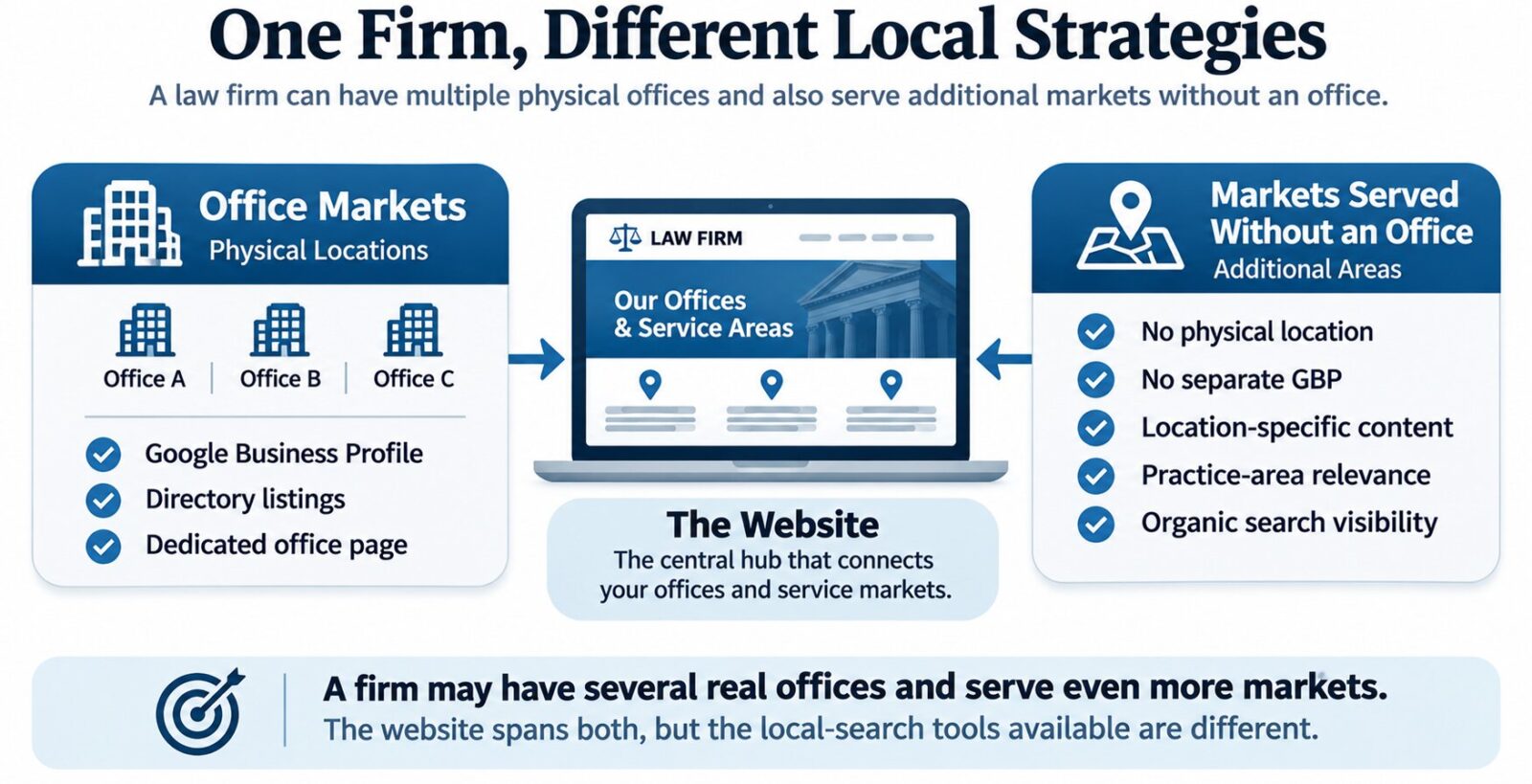
Using Websites to Support Multiple Law Firm Locations
Law firms with multiple offices can market their locations through one website or separate websites for different markets. Both approaches have advantages, but the right choice depends on how the firm operates, whether its offices share a brand, and how much content and ongoing management each website requires.
One Shared Domain
One Website for Every Office
A single website connects the firm's locations, attorneys, and practice areas under one domain. Dedicated office pages and geographic content allow individual markets to develop their own organic search visibility.
- Advantages: Centralized management, consistent branding, shared SEO efforts, and easier coordination of content and internal links.
- Challenges: Larger websites require careful organization, particularly when offices offer different services or compete in overlapping markets.
Separate Domains
Different Websites for Different Markets
Separate websites allow offices or legal practices to develop distinct identities and geographic strategies. This approach may make sense when locations operate independently, use different brands, or serve substantially different audiences.
- Advantages: Greater control over local branding, content, and marketing priorities for each website.
- Challenges: Separate SEO campaigns, additional maintenance costs, and the need to build each domain's search presence independently.
For most firms operating under one brand, a shared website is the more practical starting point. A well-planned law firm website structure can support multiple offices without requiring separate domains. Firms considering independent websites should have a meaningful business reason for that separation rather than assuming each city needs its own domain.
Developing Content for Multiple Law Firm Locations
Location-specific content helps law firms connect their services to the cities and communities they serve. A firm operating in several markets needs more than a list of office addresses. Its website should explain which attorneys and legal services are available in each location and provide useful information for prospective clients.
That doesn't mean every office needs an identical collection of pages with different city names. Effective SEO content for law firms should reflect meaningful differences in services, local demand, legal considerations, and the people each office serves.
Location Pages & Practice-Area Content
A law firm may need dedicated pages for its physical offices alongside content targeting specific legal services in each market. These pages serve different purposes:
- Office pages: Establish where the firm operates, including addresses, contact information, attorneys, and services available at each location.
- Location-specific practice-area pages: Explain how the firm's services relate to a particular market, such as personal injury representation in Boston or Springfield.
- Service-area content: Address cities where the firm represents clients without maintaining a physical office, while accurately describing its geographic reach.
Keyword research and search intent can help identify which combinations of practice areas and locations deserve dedicated content. Not every city or service needs its own page.
The good news? Your Rhode Island attorney might focus on probate law while your Boston office primarily handles personal injury cases. Those differences create opportunities to target distinct searches, address state-specific legal questions, and connect prospective clients with attorneys who handle their particular needs.
Avoid Duplicate & Doorway-Style Location Pages
Replacing one city name with another doesn't create useful local content. Pages should reflect meaningful differences in services, attorney availability, local legal considerations, or experience serving the market. Creating dozens of nearly identical pages primarily to capture search traffic may also violate Google's doorway abuse policy.
Using Paid Ads to Reach Specific Markets
Google Ads can help law firms direct attention toward specific locations, practice areas, or business opportunities. Rather than advertising every service equally across every market, firms can use geographic targeting to support particular goals:
- Promote specific legal services: Target a class action, niche practice area, or new attorney handling traffic violations in a particular market.
- Balance practice-area visibility: Use paid campaigns to support services that aren't attracting enough organic traffic while prioritizing SEO efforts elsewhere.
- Introduce a new office: Build awareness of a newly opened location before its local organic presence is well established.
Campaigns should direct prospective clients to relevant geographic or practice-area landing pages rather than automatically sending everyone to the homepage. Our Google Ads for law firms chapter covers campaign strategy in greater detail.
Optimizing GBP & Directories for Multi-Location Law Firms
Each eligible law firm office needs an accurate local presence that reflects its relationship to the larger firm. Google Business Profiles, directory listings, and client reviews all contribute to how prospective clients find and evaluate individual offices.
| The Platform | Multi-Location Priorities |
|---|---|
| Google Business Profiles | Give each eligible office its own Google Business Profile, with accurate hours, contact information, and a link to the corresponding office page. Cities without eligible locations shouldn't have separate profiles. |
| Legal Directories & Local Listings | Check that addresses, attorney information, and office details match across relevant directories. Some platforms support individual locations, while others organize listings around firms or attorneys. These distinctions matter for local SEO and help avoid duplicate or misleading profiles. |
| Reviews & Reputation | Evaluate reviews and reputation by office rather than relying on the firm's overall rating. Encourage genuine feedback, respond professionally, and address concerns specific to each location's clients. |
Measuring Multi-Location SEO Performance
Multi-location SEO performance should be evaluated by market, not just across the firm's website as a whole. An office generating significant traffic may produce fewer qualified inquiries than a smaller location. Comparing results helps identify where marketing is working and where additional attention is needed.
GBP Performance
Compare website clicks, call interactions, and direction requests for each eligible office using Google's Business Profile performance reports.
Website Traffic & Conversions
Use Google Search Console to compare clicks, impressions, and queries for location-specific pages. GA4 can help track organic traffic and form submissions, revealing which pages attract visitors and which generate inquiries.
Local Search Rankings
Track how each office appears in Google Maps and organic search results for relevant legal services. Rankings can vary considerably across neighborhoods and cities, so comparisons should reflect the markets each office actually serves.
Qualified Leads & New Cases
Use intake records or a CRM to identify which offices generate inquiries that turn into clients. Strong traffic with few inquiries may also signal opportunities for conversion rate optimization.
Is Marketing Multiple Law Firm Locations Worth the Investment?
Marketing multiple offices can be worthwhile when each location has a realistic opportunity to attract new clients and generate profitable cases. But expanding a law firm's geographic reach doesn't mean every office deserves the same budget or level of attention.
- Newer offices: May require more investment in content, local visibility, and advertising to establish a presence in competitive markets.
- Established offices: May benefit more from improving existing pages, strengthening local rankings, and converting more inquiries into clients.
Firms should weigh those investments against local demand, competition, case value, and qualified inquiries. The goal isn't to dominate every market equally. It's to invest where the firm can serve clients effectively and build a sustainable source of new business.