

Measuring Law Firm Marketing ROI
Part 4, Chapter 3: Understanding What Your Marketing Investment Produces
Table of contents
Generating thousands of website visits, hundreds of inquiries, and dozens of consultations doesn't necessarily mean a law firm's marketing is profitable. Traffic, rankings, and lead volume help measure activity, but they don't tell the whole financial story.
Law firm marketing ROI measures what a firm earns from its marketing investment compared with what it spends. Looking at retained clients, revenue, and acquisition costs helps firms evaluate performance, compare marketing channels, and make better decisions about where to invest their budgets.
Key Takeaways
- Marketing ROI measures financial return, not just activity. Website traffic, rankings, and lead volume don't establish whether marketing produces profitable business.
- Revenue and profit are different. Attorney time, case expenses, and other service costs affect how much of the revenue generated by marketing becomes profit.
- Not every case produces the same return. Practice area, case value, acquisition costs, and time to collect fees influence marketing profitability.
- ROI helps guide marketing budgets. Tracking financial results across channels helps firms identify worthwhile investments and recognize when adjustments are needed.
Measuring Marketing ROI for Your Law Firm
Marketing ROI connects a law firm's marketing expenses to the financial value of the business those efforts generate. It provides a way to evaluate whether SEO, paid advertising, local search, and other investments produce worthwhile returns.
Revenue-Based Marketing ROI
(Revenue − Marketing Investment) ÷ Marketing Investment × 100
Expressed as a percentage
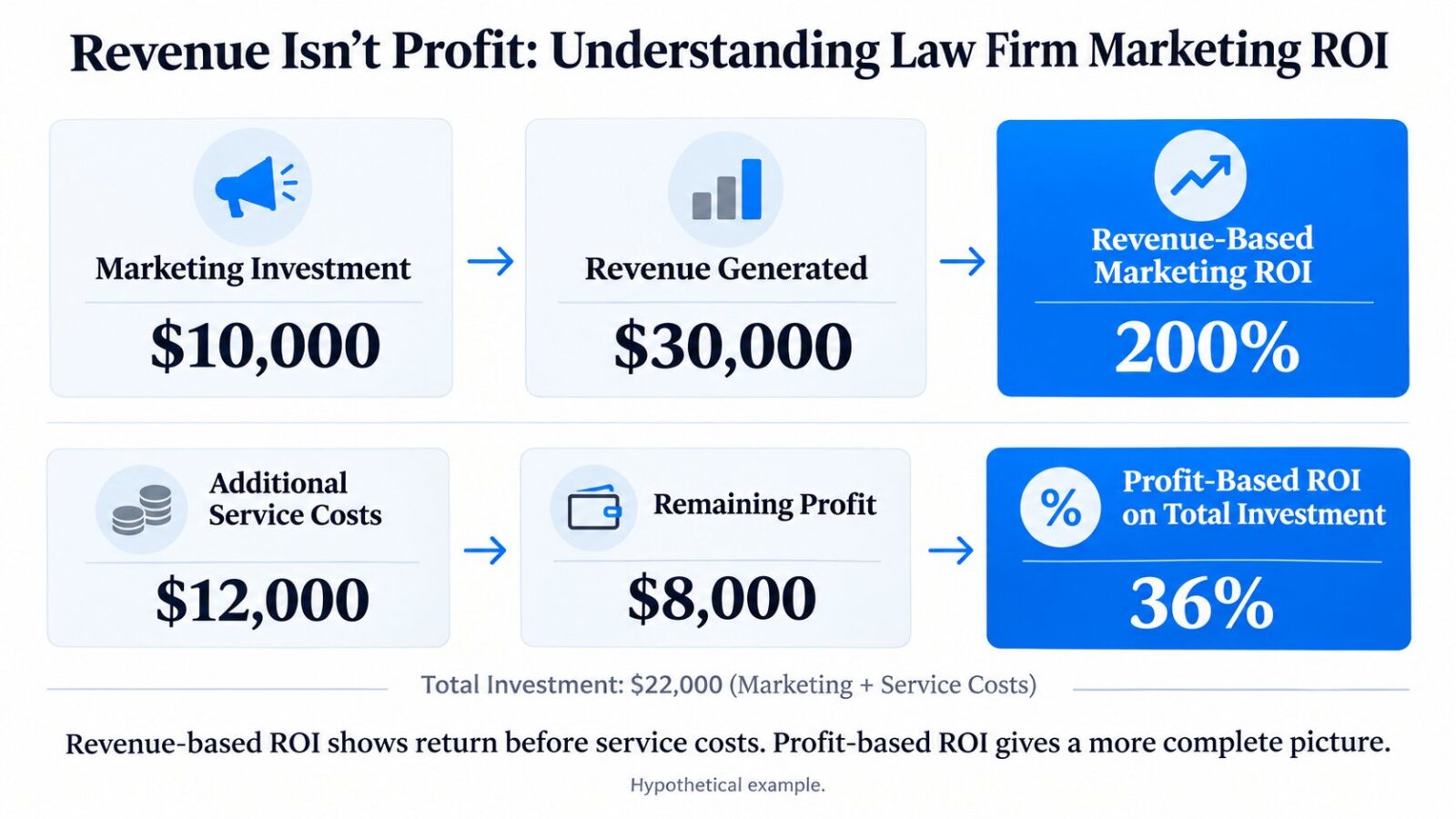
For example, if a law firm spends $10,000 on marketing and generates $30,000 in attributable revenue, the calculation produces a 200% revenue-based ROI. The firm generated $3 in revenue for every $1 spent on marketing.
However, revenue isn't the same as profit. A firm generating $30,000 in revenue from a $10,000 marketing investment still has to account for the cost of serving those clients. Attorney time, staffing, and case expenses can substantially reduce the financial return, even when the revenue-based ROI looks strong.
What Affects Law Firm Marketing ROI?
Law firm marketing ROI depends on the value of new cases, the cost of acquiring clients, and the expenses involved in providing legal services. Practice areas, fee arrangements, and case timelines can produce very different financial returns, even when two firms spend the same amount on marketing.
Practice Area & Case Value
A personal injury firm pursuing high-value contingency cases has different financial expectations than an estate planning practice offering flat-fee services. The number of clients acquired matters, but so does the revenue each matter ultimately produces.
Client Acquisition Costs
Competitive practice areas and geographic markets can require greater investment in advertising, SEO, and other marketing efforts. A higher acquisition cost isn't necessarily a problem when the resulting cases generate enough revenue to justify it.
Lead Quality & Client Conversion
A campaign may produce plenty of inquiries without generating much new business. The percentage of qualified leads that become retained clients affects the value of that investment. A firm's intake and lead management processes also influence those outcomes.
Fee Collection & Case Expenses
Some firms collect fees shortly after beginning representation, while others may wait months or years for a matter to conclude. Attorney time, staffing, litigation expenses, and other costs also affect profitability. A promising case doesn't necessarily produce an immediate financial return.
Tracking Marketing Investment & Client Revenue
Calculating law firm marketing ROI requires more than comparing an advertising budget with the number of leads generated. Firms need to connect their marketing expenses with the clients they acquire, the fees they collect, and the costs associated with handling those matters.
01. Total Marketing Investment
Advertising spend, SEO services, website development, content production, agency fees, and other expenses associated with attracting clients.
02. Lead Sources
Where inquiries originate, including organic search, paid advertising, local search, referrals, and other channels.
03. Retained Clients
Which inquiries become new matters, rather than stopping at phone calls, form submissions, or consultations.
04. Collected Fees
Revenue actually received from those matters, not simply projected case values or anticipated settlements.
05. Service Costs
Attorney time, staffing, case expenses, and other costs that affect the profitability of the work acquired.
Connecting those records is often harder than collecting them individually. A prospective client might discover a firm through organic search, return later through a Google ad, and eventually call after reading reviews. Giving all the credit to the final interaction can misrepresent how the firm's marketing contributed to that client relationship.
Consistent intake records, lead tracking, and accounting data help firms evaluate marketing performance without assuming every retained client can be attributed perfectly to a single channel.
Understanding ROI Across Law Firm Marketing Channels
Law firm marketing channels have different costs, timelines, and ways of producing new business. A Google Ads campaign may generate inquiries shortly after launch, while SEO and local search efforts often require sustained investment before delivering consistent results. Comparing their returns requires looking at more than a single month's revenue.
| Marketing Channel | ROI Considerations |
|---|---|
| SEO & Content Marketing | SEO often requires sustained investment before producing a measurable financial return. However, effective SEO content can continue attracting prospective clients long after publication, potentially improving its return over time. |
| Paid Advertising | Paid advertising can produce inquiries shortly after launch, making campaign costs easier to connect with lead activity. But those leads may not become retained clients or generate collected fees within the same reporting period. |
| Local Search | Prospective clients may discover a firm through its Google Business Profile without ever visiting the website. This makes local search valuable for generating direct inquiries, although its financial contribution can be difficult to separate from organic search and reputation efforts. |
| Legal Directories & Lead Platforms | The value of legal directories and paid lead platforms depends on how many inquiries become paying clients. A predictable subscription fee or cost per lead doesn't guarantee a favorable return, particularly when several firms compete for the same prospective client. |
Using Marketing ROI to Make Business Decisions
Marketing ROI helps law firms decide where to increase investment, improve performance, or reduce spending. Those decisions should reflect the firm's financial results, case priorities, and capacity to accept new clients rather than whichever channel reports the highest ROI.
Invest More in Proven Sources of Profitable Clients
A campaign that consistently attracts profitable cases may deserve additional investment. If a firm spends $5,000 to acquire clients who generate $25,000 in collected fees, increasing that budget could help attract more of the same business.
Before expanding, examine whether the campaign has room to grow. The next $5,000 won't necessarily produce identical returns, particularly if competition or limited search demand increases advertising costs. The firm also needs the capacity to handle additional clients. When those conditions support expansion, increasing investment in a proven campaign may make more sense than starting something new.
Turn Existing Traffic Into More Clients
A website receiving 1,000 qualified visits each month but generating few inquiries may benefit more from conversion rate optimization (CRO) than additional advertising.
Potential improvements include:
- Making contact options easier to find and use.
- Reworking pages that attract visitors but rarely produce inquiries.
- Clarifying which legal matters the firm handles.
Improving how a firm turns website visitors into leads can generate more opportunities without increasing traffic. The financial benefit depends on whether those additional inquiries become retained clients.
Stop Spending on the Wrong Prospective Clients
A campaign might generate dozens of inquiries while attracting very few cases the firm actually wants. For example, a personal injury practice receiving mostly minor property damage inquiries may need better targeting rather than more leads.
Refining keyword research and search intent targeting can help firms concentrate spending on relevant matters. Before reallocating a budget, consider:
- How many inquiries meet the firm's case criteria.
- Which markets produce profitable clients.
- Whether acquisition costs justify the collected fees.
Why Marketing ROI Changes Over Time
Law firm marketing ROI can change significantly depending on when it's measured. Marketing expenses often occur months before the resulting cases generate revenue, making early returns appear weaker than they ultimately become.
Two law firms each invest $10,000 in marketing but see very different timelines for their returns. An estate planning firm charging flat fees may collect revenue shortly after retaining new clients, while a personal injury firm working on contingency fees could wait months or years before receiving payment.
Firms can evaluate performance at several stages:
Early Results: Marketing costs, qualified inquiries, and new client engagements indicate whether campaigns are attracting worthwhile opportunities.
Developing Results: Collected fees begin showing how those opportunities translate into revenue.
Long-Term Results: Completed matters provide a clearer picture of profitability, while ongoing SEO performance may continue generating clients beyond the initial investment.
Comparing results over appropriate reporting periods helps firms avoid cutting promising investments prematurely or overestimating campaigns whose financial returns haven't materialized.
Knowing When Your Marketing Is Worth the Investment
Strong marketing doesn't necessarily mean more traffic or more leads. It means attracting worthwhile business at a cost that makes financial sense. A few signs include:
- Better cases: More retained clients whose matters match the firm's practice areas and priorities.
- Reasonable acquisition costs: Marketing expenses remain proportionate to the revenue and profit those clients generate.
- Consistent returns: Results justify continued investment when measured against realistic case timelines.
A firm doesn't need every marketing channel to deliver the same return. It needs to know which investments are producing business worth pursuing.